The perspective
Social movements in the name of Black lives are gaining visibility internationally, but as part of this, the reallocation of economic resources must be prioritised on a global scale.
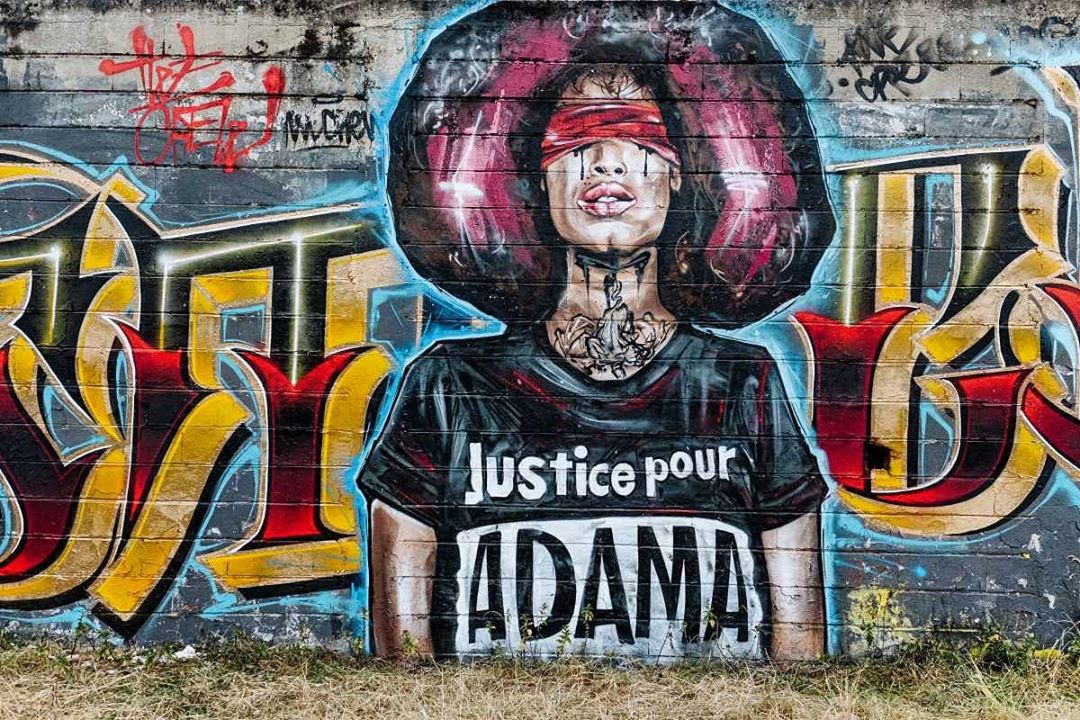
Social movements in the name of Black lives are gaining visibility internationally, but as part of this, the reallocation of economic resources must be prioritised on a global scale.
On 13 June 2020, I stood with a few French friends on the corner of Boulevard de la Villette and Rue du Faubourg du Temple discussing the rise of socialism in the United States. We had forked off from the Vérité pour Adama manifestation (“Truth for Adama” protest) and, along with a few thousand others, had marched through traffic up the hill to the Belleville neighbourhood. In this quartier – populated largely by migrants from East Asia or North Africa, or their children and grandchildren – the stalled traffic responded with cheers, honking horns and raised fists, while the protesters clapped and cheered in accord. Chants and signs echoed those originating in the Anglo world, “Black Lives Matter”, in English, alongside the familiar “Pas de Justice, Pas de Paix” (“No Justice, No Peace”), as well as more local slogans such as “Vérité pour Adama” or the beloved and now time-tested “Macron, démission!” (“Macron, resignation!”). For me, the noise, discord and togetherness were a great relief after two months of one of the strictest quarantines in the world.
The Vérité pour Adama movement responds to racist policing in France and demands truth and justice after Adama Traoré, a 24-year-old Black man from the Val-d’Oise department just outside of Paris, died in police custody. After four years of medical exams, the autopsies have been inconclusive.
Here, I consider the similarities and differences between French and US movements around the issues of racial justice and police violence. Both movements have the same underlying demands for the respect and protection of Black lives, and these demands crystalize particularly in moments of austerity. In France, the movement addresses itself largely to the state, citing its alleged commitment to equality, welfare, justice and truth. In the US, the demands are similar but focus more on dismantling state structures that enforce racial and economic inequalities. At the same time, socialism is on the rise among younger generations in the US and the #8toAbolition platform calls for the reallocation of resources to sustaining communities as a crucial step to abolishing the police state.
As we stood at that intersection of the two main streets in Belleville, my French friends started talking about how they were interested in studying the growth of socialism in America. I was puzzled at first – it seemed strange to me, in a place where the welfare state still has some shaky legs to stand on, to be looking to the US. But there are some things the French left admires about the US left. For one, the recognition of identity as a category of oppression is still something that is resisted by the centre-left in France, although contingents of the far left and younger generations acknowledge it more. The French left won its power through socio-economic struggles – and while the radical history of France also fought against colonialism, for racial justice, and for sexual and gender liberation – the prevailing left in France hangs its hat mostly on fights over union power, labour law and taxation practices.
Redistributive justice is certainly the bottom line of any struggle for liberation, but in a country plagued by a history of racism, sexism and anti-immigrant structures, focusing purely on bread and butter issues like pensions, job security or family leave excludes many comrades and contingent workers whose work is not recognised by labour laws, who don’t have pensions, and whose gender or chosen family is not acknowledged as medically, legally or existentially valid. In France, by and large, the struggle has been for equity and inclusion in these existing structures. The US, on the other hand, while one of the most economically punishing places in the world, has also been home to some of the most beautiful and inspiring examples of mutual aid, protest culture and liberation movements, including the Black Panther Party, ACT UP, the Seattle Alterglobalization movement, Occupy Wall Street, #MeToo, and now multiple waves of Black Lives Matter protests. As one French colleague explained it to me, “it’s the only place in the world that can make these amazing movements out of total shit.”
French policing has drawn international criticism because of the disproportionately harsh policing of the poorer banlieues during confinement, where admittedly, larger families live in smaller quarters and were less successful at quarantining themselves.
In the working-class banlieues (“suburbs”) where the Vérité pour Adama movement began, police violence is nothing new and has been a long-running problem and trigger for unrest. In the autumn of 2005, a series of protests and riots broke out sparked by the death of two adolescent boys who were hiding from the police in an electrical switching station and were accidentally shocked to death. The fact that the boys instinctively ran from the police – to their death – rather than expecting protection or justice was seen as an articulation of how the state treats largely Black and brown, and largely immigrant or first-generation, poorer populations in the banlieues. The banlieues went up in flames in anger: 10,000 cars were burned, 3,000 people arrested, and a state of emergency was declared.
The lockdown has exposed further issues of inequality, including living conditions and police violence in the banlieues. French policing has drawn international criticism because of the disproportionately harsh policing of the poorer banlieues during confinement, where admittedly, larger families live in smaller quarters and were less successful at quarantining themselves. In the midst of this, the Vérité pour Adama movement has gained traction and has become France’s “Black Lives Matter” in many ways – taking the case of Traoré as an example of the overarching threat of the police and their lack of accountability vis-à-vis these populations.
The demands of the movement differ in some ways from the Black Lives Matter movement in the US. One main difference is that there is little discussion of police abolition. In addition to an urgent emphasis on the recognition of the value of Black lives, the French movement focuses on more republican themes like justice, truth and equality, which are owed to the people by the state. French anarchist platforms have indeed published manifestos, “triggered by the assassination of George Floyd in the United States”, calling for the abolition of the police, but the comité pour Adama has focused on justice for victims of police violence, rather than on defunding.
However, budgets are still an issue – pensions, health care, public transit and education are all being contested at the moment, and all have their own protests, strikes and social movements forming in their defence. While the US left has developed strong attention to mutual aid and identity politics, this might be in part because there is barely a welfare state to hold people together and of which to make demands. But, like the police, the assaults on the welfare state in France won’t attack everyone equally – the poorest and most vulnerable will suffer the most. Some of the key demands of the US abolitionist movement call for an investment into something like a welfare state, which will support communities before they fall victim to the social ills that the police might be called to react against.
What remains to be seen, as with all other nations struggling against austerity in our current moment, is whether we can succeed in a true convergence des luttes – whether there will be a redefining of what is “essential” to human life and whether we will recognise and protect Black lives, not just within the nation but globally. If so, it will certainly require a conflict with, and overthrowing of, the forces that exist to enforce inequality and which harvest our resources and lives. In other words, this struggle requires not just an end to police violence but a reallocation of economic resources, from institutions that operate through violence to ones that support life, education, art, childcare and health. A clear distinction needs to be made between a welfare state and a police state, and we might find that the boundaries of the nation state may be insufficient to bring about the required economic reforms. The greatest struggle of these movements may be to bridge this gap from the local, municipal or national, to the global – which is, indeed, the geopolitical terrain from which oppressive power is exercising itself.
Photo Credit: Twitter