
‘’Forcing a woman to marry, to continue a marriage or kidnapping her in order to marry without her consent, is a violation of Kygyz criminal law, Islamic Sharia Law, Kyrgyz tradition (adat), and of her fundamental human rights of security, freedom and equality.’’
Dr Russell Kleinbach, Kys Korgan Institute.
The once romantic gesture of a groom taking away his bride-to-be on horseback has now become a distorted form of bride kidnapping in Kyrgyzstan, known as ala kachuu.
There are many misconceptions about the tradition of bride kidnapping, from a belief that it is an Islamic practice, to the belief that it only occurs in the most rural parts of Kyrgyzstan. In fact, it takes place in all parts of Kyrgyzstan; both rural and urban areas, remote villages and bustling cities, and it can find no premise in the Islamic religion. Studies have shown that forms of bride kidnapping are also prevalent in neighbouring countries such as Turkmenistan, Kazakhstan, Chechnya and the Caucus.
A typical kidnapping is often conducted by a group of males who take the bride to their home. The bride is often isolated and kept under the charge of the kidnapper’s female relatives, chiefly the groom’s mother or grandmother. The white veil is known to mark when the wedding occurs and it is at this point that the brides can no longer go back to their families. Even when sex does not take place, once a woman has been kept overnight – even for a single night – her virginity is put in doubt. Her natal family will, unfortunately, then be reluctant to take her back in what used to be her family home due to societal stigma.
There is debate as to whether the issue of bride kidnapping revolves around gender battles. However, upon closer examination, the situation is far more complex. Restless Beings, a humanitarian non-profit organisation, seeks to raise awareness of ala kachuu and combat its practice by working with Kyrgyz organisations. They also offer counselling to Kyrgyz women affected by ala kachuu. During a research trip undertaken by the directors of Restless Beings in April 2011, they interviewed women affected by ala kachuu and were able to understand more about the practice. For many men ala kachuu is believed to be a rite of passage into manhood, and for some less attractive men, it is a way to secure marriage. However, women play a significant role in the process of the kidnapping too. It is equally the female members of the family that hold the abducted girl against her will and pressure her into acceptance of the marriage.
Inevitably, most of these marriages result in domestic violence, repeated rape, forced abortions, and eventually broken families. Worse still, many women remain isolated and alone. Some victims of ala kachuu are compelled to commit suicide.
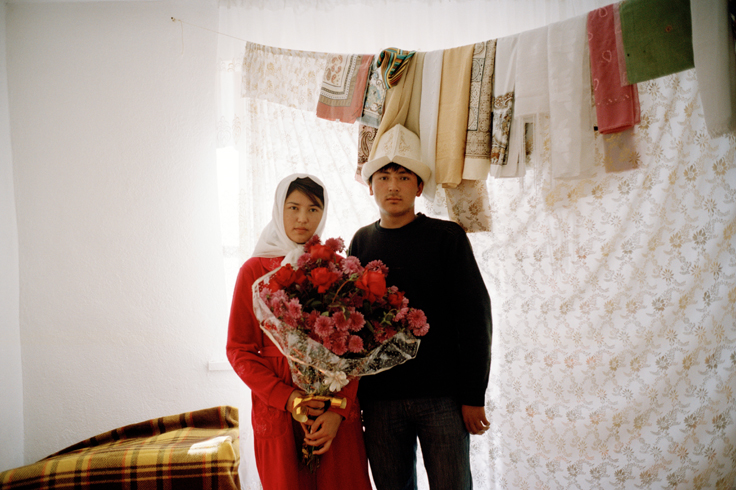
There are many reasons that women stay with their new husbands and accept the ‘marriage’. In some cases, the kidnappings are so violent and brutal that the women believe they are going to be killed; when faced with marriage, they see it as a better option. Facing ostracisation from their society is often also reason enough to accept. The minimal choices that these women have limit them in every form, from family and social circles to their work and education. Studies by the Kyz Korgon Institute, an NGO dedicated to the prevention of non-consensual marriage, show that women in urban areas are more likely to leave their husband due to job prospects and security, compared with women in rural areas.
What is notable is that the law is able to do little to physically combat the practice. Although bride kidnapping has been criminalised in Kyrgyzstan’s constitution and made its criminal status apparent, law enforcement agencies largely see the practice of ala kachuu as a cultural phenomenon, therefore, it is not viewed as a crime, and deterrence and punishment is rarely implemented.
Understandably, there are great challenges when dealing with tradition and attempting to alter the way people practice certain beliefs. However, when a tradition becomes distorted and corroborates the destruction of women’s rights and freedoms, action needs be taken.
As a young country, having only gained independence in 1991, the issue of ala kachuu is worrying considering the number of reported cases are growing at alarming rates. It is thought that the collapse of the Soviet Union and a consequent attempt at reviving Kyrgyz tradition, have led to the resurgence of the practice. Investigations into ala kachuu are often difficult due to the sensitivity required, but researcher Russell Kleinbach, Deputy Director of the Kyz Korgon Institute, has estimated that an astonishing 50% of marriages in the country are the result of ala kachuu. Furthermore, research suggests that of these marriages, around two-thirds are non-consensual. With both the law enforcement agencies, and society as a whole, accepting and overlooking the practice, figures of women affected by ala kachuu continue to rise.
Recently, in November 2011, the Kyrgyz government highlighted the issue. However, although their actions have made little impact and may have been a form of appeasing international human rights organisations, by the very nature of bringing it up on their agenda they have taken a more combative approach.
Raising awareness of the detrimental effect to women and society at large, coupled with the full application of the law by the state. Educating and encouraging the young male population to step away from past traditions is the route to endorsing a future of choice for women. It comes as no surprise that changing such ideas lie with the youth, the future generation of decision makers to take society forward. Most importantly, student activists and campaigners can help find a solution from within the affected society itself.
Photo Credits: Jackie Dewe Mathews