The perspective
Despite the sexism that plagues mainstream awarding bodies, Greta Gerwig’s exceptional directing of Little Women has ensured that the film is classic yet current, portraying memorable and relatable definitions of femininity.
Despite the sexism that plagues mainstream awarding bodies, Greta Gerwig’s exceptional directing of Little Women has ensured that the film is classic yet current, portraying memorable and relatable definitions of femininity.
*Contains spoilers
Greta Gerwig hasn’t shied away from female storytelling in the past, with her Golden Globe winner Lady Bird touching our hearts back in 2017. So, naturally, when her adaptation of Louisa May Alcott’s 19th-century classic Little Women (1868-9) was announced there was no other filmmaker deemed more appropriate to take on this project. With a female-centric narrative and a variety of strong female leads, Gerwig – a female filmmaker giving a big “f*ck you” to a predominantly straight white male industry – hit the ground running with this fresh literary adaption.
This is a film that pays homage to Alcott and takes inspiration from her writing:
“I just feel like… women, they have minds, and they have souls, as well as just hearts, and they’ve got ambition and they’ve got talent, as well as just beauty, and I’m so sick of people saying that love is just all a woman is fit for. I’m so sick of it. But I’m so… I’m so lonely.”
This plea by protagonist Jo March (Saoirse Ronan) is one of the most heart-breaking moments of the film, in a scene which was especially poignant for me because it exemplifies the female voices that carry the power of words. Gerwig’s scriptwriting and Ronan’s performance allow audiences to sit within that dialogue and contemplate. It is truly mesmerising. These words really hit home for me – I’ve never heard such an accurate portrayal of what it means to be a woman, spoken so eloquently and yet with so much pain.
What is so interesting about this quote is that it is not from Alcott’s Little Women, but it is in fact from one of her later books titled Rose in Bloom (1875). By bringing our attention to Alcott’s lesser known work, we know that Gerwig doesn’t want to just flippantly recreate what has been done before, she listens and aims to inject an authenticity into the story that we didn’t know existed elsewhere.
I just feel like… women, they have minds, and they have souls, as well as just hearts, and they’ve got ambition and they’ve got talent, as well as just beauty, and I’m so sick of people saying that love is just all a woman is fit for. I’m so sick of it. But I’m so… I’m so lonely.
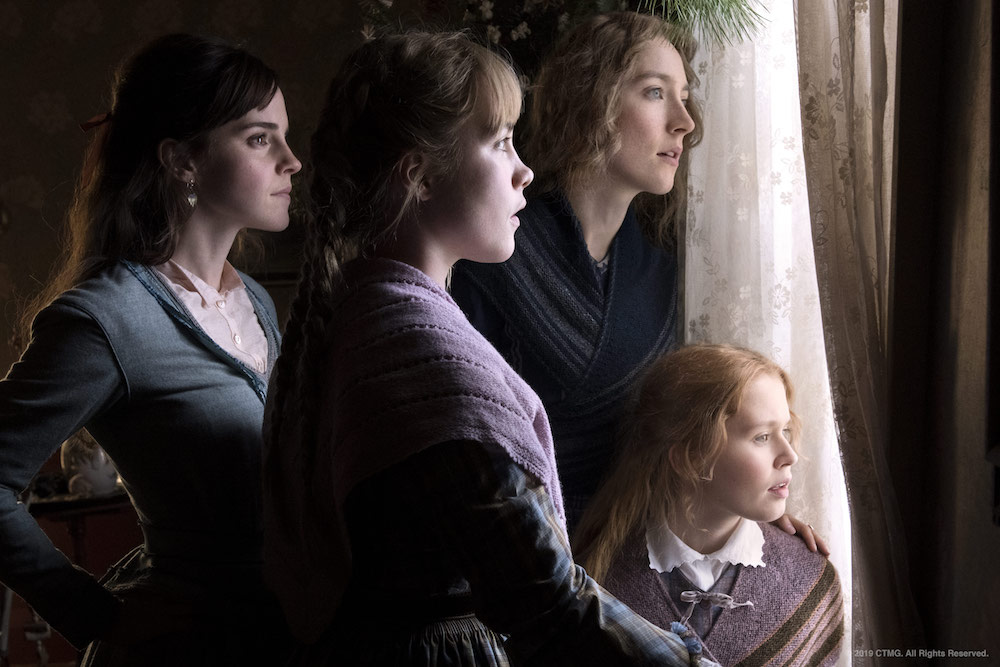
Gerwig’s fresh takes don’t stop there. Her bold decision to tell this very classic tale through a non-linear narrative keeps audiences engaged and fully utilises the innovation that can be conceived through adapted screenplays. It certainly stands out among its predecessors. Gerwig brings Alcott’s progressive thinking to life within this female friendship narrative and I soaked up every minute of it. Jo, Meg (Emma Watson), Amy (Florence Pugh), Beth (Eliza Scanlen) and Mary (Laura Dern) are given due attention, all of them representing such diverse talents and definitions of womanhood.
Gerwig, Ronan and Timothée Chalamet, having previously worked together in Lady Bird, are the power trio that will always have me throwing my money at a cinema ticket. Pugh, however, is especially compelling as the young Amy, channelling humour, naivety and charm, cloaked within an extremely effective fringe! Her performance embodies everything about female coming-of-age including the harsh realities that permeate womanhood. Mature Amy wears the scars that growing up has inflicted on her; she sees the world for what it is and conforms to it reluctantly. Pugh displays an impactful characterisation that uplifts the oppressive moments of this feminist tale. Even the smallest of roles are played with a palpable dedication as Watson, Scanlen, Dern and Meryl Streep are by no means in the spotlight, but still have no trouble catching the attention of the crowd. We know that Gerwig has dedicated her time and compassion to writing these characters the way Alcott intended them, taking special care to present distinct femininities that every woman deserves to witness on the big screen.
That is why it is so devastating that the awards season has commenced, with very little attention or praise given to Gerwig’s exceptional direction. The Golden Globes aired on television earlier this month complete with a heavy dose of testosterone. Little Women, unfortunately, received only two nominations: one for best original score – an element of the film which wasn’t exactly more notable than its other breathtaking qualities – and unsurprisingly, one nomination for best actress which went to Saoirse Ronan.
It is a disgrace that the film was snubbed of a best motion picture nomination and even more outrageous that Gerwig was overlooked in the best director category. It’s our duty as spectators to assure Gerwig and other women in film that we see them, we admire them and we urge them to keep going, despite the blatant sexism and uniformity that plagues the awarding industries.
I couldn’t finish without addressing one striking contribution to Little Women. Jacqueline Durran’s costume design is an asset to this film. I was sat absolutely in awe of the striking costumes threaded throughout, each one telling a story, from Jo’s androgynous cap and waistcoat to Meg’s falsely affluent pink ball gown. One of the reasons why Durran is so extraordinary is her ethical philosophy towards costume in film and television. Durran aims for sustainability in her designs and has achieved this in many films, including a 100% sustainable costume for Belle in Beauty and the Beast (2017). At a time when the climate crisis is reaching unpredictable peaks, Durran is making a doubly bold statement in Gerwig’s film.
Little Women may just be my favourite film of the year – it hits all the right notes and showcases an array of female talent. The relationships presented between the March women will overwhelm audiences with a profound sense of gratitude for their own loved ones, as Gerwig’s script drives home the message of unconditional love and sisterhood.
Photo Credit: Sony Pictures