
White people can support marginalised individuals and communities through direct and indirect methods
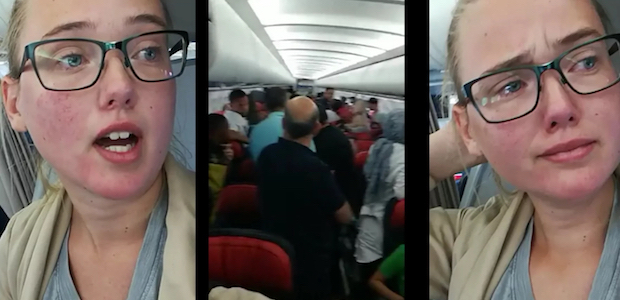
Many, by now, will have heard of the lone Swedish activist, Elin Ersson, refusing to take her seat on the Gothenburg flight in order to prevent the deportation of a young Afghan man. It is important to mention for this piece that the young man, Ismail Khawari, was deported back to Afghanistan the following day.
My interest here is more about the role of privilege and how it can be deployed in order to rupture. My focus will be on white allies and how they can, productively and actively, stand side by side with those marginalised and disenfranchised in the fight against white supremacy. Recognising how such privileges can help dismantle power structures using tangible, everyday acts prove not only compelling but an absolute must. Ersson, when boarding this flight, was evidently conscious and aware of the power she held in carrying out her direct action, albeit for a temporary period, and utilised it to dissent those she was facing. No doubt there will be legal consequences for her; however, no struggle in history has been successful without facing the brutality of those in power.
What further allowed her to assert her privilege was the use of social media platforms and her live streaming of the incident. This facilitated an interaction with an audience who could take not only inspiration from her, but also lend their hand in solidarity. Social media, despite many of its criticisms, demonstrates the sheer power of disseminating dissent, allowing room for discussions on abuses of asylum seekers and the power structures that enable them. But as much as this social media avenue democratises the platform for protest, it is essential to remember that even the attempt at such a protest reveals an inequality, and is most certainly tied to privileges not extended to all.
I personally admire Ersson and her bravery in standing up for her principles. The moment of frustration while watching the video was hearing a British man try to interrupt and manhandle her as he attempted to snatch her phone from her. Such public protests, especially when done alone, require an immense amount of strength and willpower. She received some solidarity from a fellow passenger, although it was clear that the lack of support caused her a great deal of anxiety and stress.
Direct action implies the use of actual physical, social and economic power to demand a change. A significant example from history would be that of Peter Norman, the Australian athlete who, in the 1968 Olympics, stood up against racism in sport by wearing the ‘Olympic Project for Human Rights’, which cost him his career. Or here at home, it would be that of Jeremy Corbyn when he took a stand against the apartheid in South Africa. A more recent example of direct action took place in France, in which a group of people subverted the decision to deport a Sudanese man from their town. In this small village, “1 in 4 people signed a letter demanding his regularisation, and half the town physically fought the police.” Yes, these strategies employed as a form of intervention may be more risky, but the centrality of white allies deploying themselves in this manner is crucial. Considering the current political discourse surrounding BAME communities, following the Brexit vote as well as the rise of the far-right, it is of upmost importance to have allies who are able to see the violence employed by the state, and to be able to carry out actions like those in the small village in France. Such actions literally save lives, which ultimately saves humanity.
Such privileges can also be displayed in silence as micro-interventions without having to directly or physically confront a harasser. There is a superb bystander guide created by illustrator Maeril who titled it, “What to do when you are witnessing Islamophobic harassment?” This lays out a strategic way to deploy privilege but done in a way where this person does not find themselves in harm’s way. Dissenting and expressing solidarity are absolutely vital when standing shoulder-to-shoulder with a marginalised community, although safety is of upmost importance too, which I believe is viable through micro-interventions.
As much as these privileges can be deployed by white people, it is imperative to recognise how people of colour have been treated when they have taken collective action in order to stand up to authority. People of colour have found themselves bearing the brunt of the law, in its harshest forms, when they have resisted and have had their humanity denied. Alongside the dehumanisation, many also find themselves in excruciating circumstances and also have their communities dragged with them. On the other hand, when white individuals have tapped into their privileges and done the same, as was the case with Ersson, it illustrates a power disparity instantly. This can easily be gauged through how an audience reacts and/or responds to such a protest.
Protests and direct action have always been racialised and people of colour are very much aware of this. When people of colour want to be heard, they have to do so by being much louder, and recognising the implications and consequences which are not extended to their white counterparts. For white people, displaying such a courageous act carries inherent privileges and fewer risks.
This is not to say that people of colour are in need of saving and require constant assistance of white allies. This is a mere attempt at starting a discussion on how those who seek to offer support to those marginalised should do so by recognising the power dynamics at play. People of colour know where the roots of the issues lie that affect them and do not need ‘exceptionalised’ treatment from allies. A simple act of listening what those communities want and how they would like you to get involved is a start. In fact, history has taught us that people of colour have resisted and risen despite the challenges, without allies – yet having allies by our side will surely further strengthen this fight. The fight that is on our terms and conditions.