
The perspective
There is hope yet for the Berlinale with this year’s selection of films, from a real-time depiction of Anders Breivik’s slaughter to a French film exploring religious beliefs.
There is hope yet for the Berlinale with this year’s selection of films, from a real-time depiction of Anders Breivik’s slaughter to a French film exploring religious beliefs.
The Berlinale is a strange film festival. One may find the line-up of the main competition often disappointing, especially if compared to other prestigious European film festivals such as Cannes and Venice. And yet the programme – most notably the Panorama and Forum selections – also offers plenty of gems revealing themselves almost by accident. It is a unique festival experience that is at once infuriating and extremely exciting. This was the penultimate year for Dieter Kosslick, festival director since 2001, and questions have been raised about the future of the festival, which, many argue, will need to raise its game in order to compete seriously with Cannes and Venice. Having said that, I know many critics who would happily skip their annual trip to the Croisette, but would never miss Berlin. The Berlinale may lack the glamour of its European counterparts but showcases a matchless mix of exciting experimental and political works, an extremely diverse array of international films, skilfully curated retrospectives of classics and Europe’s most important film trade fair – the European Film Market – which celebrated this year its 30th edition.
The Berlinale opened with the international premiere of Wes Anderson’s Isle of Dogs, the much-awaited stop-motion movie set in a dystopian Japanese island that brings together a stellar ensemble voice cast including Bill Murray, Greta Gerwig, Scarlett Johansson, Tilda Swinton and Yoko Ono. Anderson went on to win the Silver Bear Best Director Award, while the unexpected winner of the Golden Bear for Best Film was Touch Me Not by the Romanian director Adina Pintilie. A quasi-fictional documentary exploring alternative sexual practices and forms of intimacy, Touch Me Not left several critics underwhelmed.
It is still too early to know which of the films shown in Berlin will be released outside of the festival circuit. But there is certainly plenty to be excited about. My personal favourite was Theatre of War (orig. title: Teatro de Guerra) by Argentinian theatre maker Lola Arias. Thirty-five years after the end of the Falklands/Malvinas war, Arias invites a group of British and Argentinian veterans to face each other as former enemies. Rather than simply sharing their memories with us, the veterans restage them. Forming a theatre ensemble, they re-enact battle scenes, look together at photographs, maps and newspaper clippings, and talk to each other about their experiences at war. In a number of extremely touching scenes, the British veterans speak in broken Spanish to the Argentines; the Argentines answer back in their hesitant English. The exchanges are charged with an almost child-like desire for connectedness. In another poignant scene, a former British captain restages a military action that resulted in the killing of several Argentines. The captain holds in his arms a wounded enemy, who, just before dying, tells him in English of a trip to Oxford he had taken years earlier. The British veteran wishes the man had never spoken English to him. It is an image that torments him in his sleep, one that he will never be able to forget – he tells us.
Theatre of War does not try to look for reconciliation between enemies. Arias changes the perspective through which we normally look at wars, giving an active voice and an embodied presence to ordinary men who were sent to fight by their own countries, often without much choice, as it was the case for the Argentines who had to serve under conscription. The film may be said to restage the theatre of war, but its actors are certainly no puppets, their compassion, vulnerability, and fears so vividly present in front of our eyes throughout the film. Like Joshua Oppenheimer’s The Act of Killing, Theatre of War is a film that raises important questions about what it means to restage on screen some of history’s most painful chapters by involving directly some its actors – be they survivors or perpetrators – and about the responsibilities of the filmmaker in this process.
The most awaited film of the festival – and arguably the one that most stunned the Berlin audience with its re-enactment of the horrific mass killing that saw 69 teenagers die in Norway in 2011 – was Utøya. For 72 minutes (the actual duration of the slaughter on the island of Utøya), the film follows, in an unbroken single take, Kaja and the other teens at the Labour party youth camp where the slaughter took place, from the time they hear the first gunshots and run for their lives, to the arrival of the first rescue boats. While the camera always stays with Kaja, the audience never sees the attacker but only hears his gunshots. The shaky hand-held camera, as we follow the teens run through the forest, is likely to make viewers feel dizzy. While watching the film, I fought the temptation to leave the cinema, as I was feeling pretty sick. But I realised that this is precisely what one is supposed to experience: the gut-wrenching sense of what it might have been like to be on the island during the slaughter. The gunfire intermittently echoes in the distance, the film replicating the precise number of shots fired on the island.
While other reconstructions of the Utøya slaughter have been announced in Scandinavia (a TV series is due for international release soon), questions remain on why Poppe thought it was worth making this film. During an excruciating sequence of the film, we see the teens asking why it is taking so long for the Norwegian authorities to get to the island to stop the slaughter. But apart from that, no other significant questions seem to be raised. Is Utøya simply celebrating the lives of teens like Kaja? And yet one wonders what spectators gain from re-living this kind of stomach-turning viewing experience. The film has been hailed as a tribute to the courage of the young victims of Utøya. Perhaps it is supposed to be a cathartic experience for the survivors, the screenplay being based on accounts given by them. At the end of the screening I attended, the director, Erik Poppe, explained that he made the film by working closely with the survivors and the families of the victims, and that he sought their approval before the film’s release. Still, one may ask why the fictional drama – bringing together melodramatic tones and the heart-pounding pace of the thriller – was preferred to the documentary form.
I loved The Prayer (orig. title: La Prière) by French actor and director Cedric Khan for its brave, unprejudiced approach to the difficult themes of religion and drug addiction. Set in the French alps, the film follows a young man called Thomas (played by Anthony Bajon, who went to win the best actor award) who arrives at a religious rural sanctuary. Here, several young men are trying to kick their habit with a mix of hard labour in the fields and prayer. Thomas’ integration in this community is far from easy. This rural sanctuary seems to have banished any form of pleasure or self-indulgence, and all its members are prevented from being alone at any time. Thomas eventually accepts the rituals of this sanctuary, until he meets sister Myriam (played by Hanna Schygulla), the foundress of the sanctuary, who asks him whether he truly believes in God and whether he is happy. Thomas answers “yes”. Sister Myriam repeatedly slaps him in the face, as she knows that this is not true. It is a disquieting moment, one that potentially undoes the very sense of order that Thomas has worked so hard to achieve in his new life. While, on the one hand, the film asks its viewers to understand the comfort that praying to a God one does not believe in might bring, on the other, this unsettling moment seems to pose the question of how to be truthful to oneself in the face of those protective social, moral and psychic narratives that prevent us from sinking lower and lower.
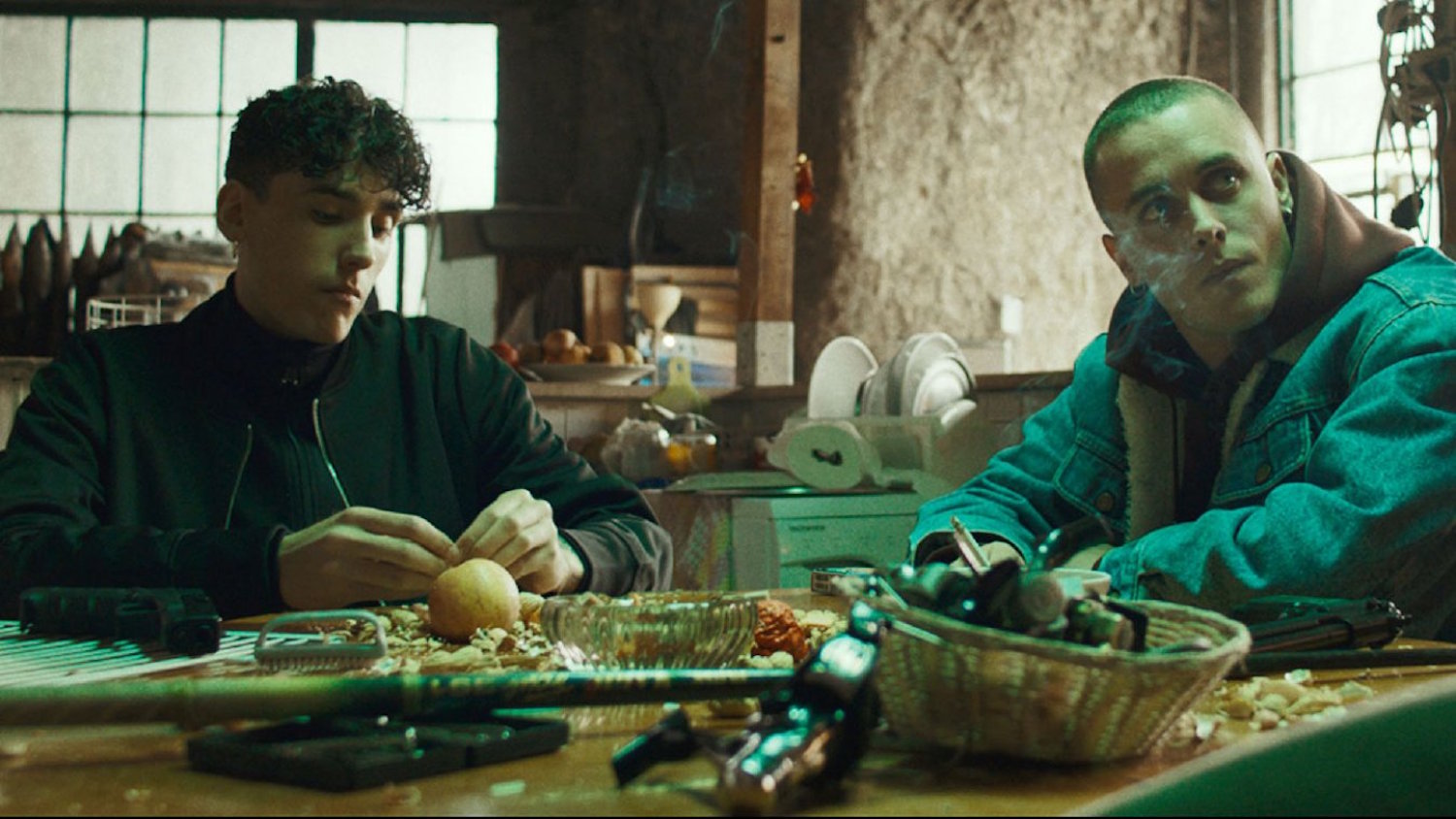
Other festival highlights included Boys Cry (orig. title: La terra dell’abbastanza), the first feature film by the young Italian twins Damiano and Fabio D’Innocenzo, a crime film set in the Roman outskirts. The film’s sophisticated visual style and the emotionally nuanced performance of the two lead actors, Andrea Carpenzano and Matteo Olivetti, impressed many critics, and are likely to guarantee the film’s general release outside the festival circuit. Other two films to watch out for are Gus Van Sant’s Don’t Worry, He Won’t Get Far on Foot starring Joaquin Pheonix who gives once again a phenomenal performance playing a quadriplegic cartoonist from Portland, and The Heiresses (orig. title: Las herediteras), a drama with an exclusively female cast that explores the precarious hierarchies and privileges of Paraguay’s upper bourgeoisie through two older lesbians who have fallen on financial hard times.
Despite its unassuming style, Berlin’s annual celebration of international cinema remains the industry’s most significant festival in Europe and welcomes audiences 10 times as large as those of Cannes. Last year, 79 high-profile filmmakers signed a letter harshly criticising the current festival’s leadership and calling for a fresh start. With Dieter Kosslik on his way out, the prospect of a new direction for the festival leaves many hoping that, in the near future at least, the curation of the program will look less scattered.
The 68th annual Berlin International Film Festival took place from 15 to 25 February 2018: https://www.berlinale.de/en/HomePage.html.
Photo Credit: Boys Cry / Berlin International Film Festival