
With new festival curators, this year’s Berlinale showcased new and underrated film talent. Enjoy three selections below.
Expectations were high for the 70th edition of the Berlinale. This year’s anniversary edition coincided with the much-awaited debut of the new festival director duo Mariette Rissenbeek and Carlo Chatrian. The Berlinale was never a glamorous red carpet-oriented film festival. Yet, this year’s edition felt even more sombre than usual. There were no big Netflix productions. Though, contrary to what happened at Cannes in the last couple of years, this did not seem like a political decision. There were also hardly any big Hollywood stars or directors. Some losses come with gains, however: the level of the main competition line-up was consistently higher than in the last few years and included the kinds of gems one would expect from the curatorial talent of Chatran, who has gained the respect of the film festival community during his much-acclaimed seven-year stint as the artistic director of the Locarno Film Festival.
One of the most remarkable films shown at this year’s Berlinale was The Woman Who Ran, a beautifully unassuming film by Korean director Hong Sang-Soo. Over the course of three days, a young woman called Gambhee visits three old female acquaintances. The women have not seen each other for a while. Gambhee compliments them on the furniture of the houses they have bought; they talk about the weather and their everyday routines. There is something deeper behind these deceptively simple, almost banal exchanges. “How can he be sincere, if he only repeats himself,” asks Gambhee about her friend’s novelist husband, who always says the same things in his frequent TV appearances.
The Woman Who Ran celebrates the value of unhurried, subdued exchanges between people who try to do their best to be kind to each other. These people are women and this seems to matter. All the encounters are interrupted by men who turn out to be quite unpleasant. One of them knocks on the door of the first house that Gambhee visits to complain about the stray cats that the women feed, explaining that his wife is scared of cats and that they should stop. The exchange is extremely courteous and yet the women stand their ground, asserting that cats are not less important than human beings and that they need food too, to the disbelief of the man who thinks humans should come first. The Woman Who Ran contains one of the best cat scenes in the history of cinema, but I will not say more so as not to spoil the fun! “I never start from any kind of generalisation about topics,” said Hong Sang-Soon during the post-screening press conference. It is a comment that might explain why this film seems so interested in the truths that lie in the small, unspectacular moments of our lives. This is not really a cinema of endurance, but a kind of cinema which is inviting us not to look for fireworks, because the fun – and the substance – may be just there, in the everyday scenarios that most of us already live.
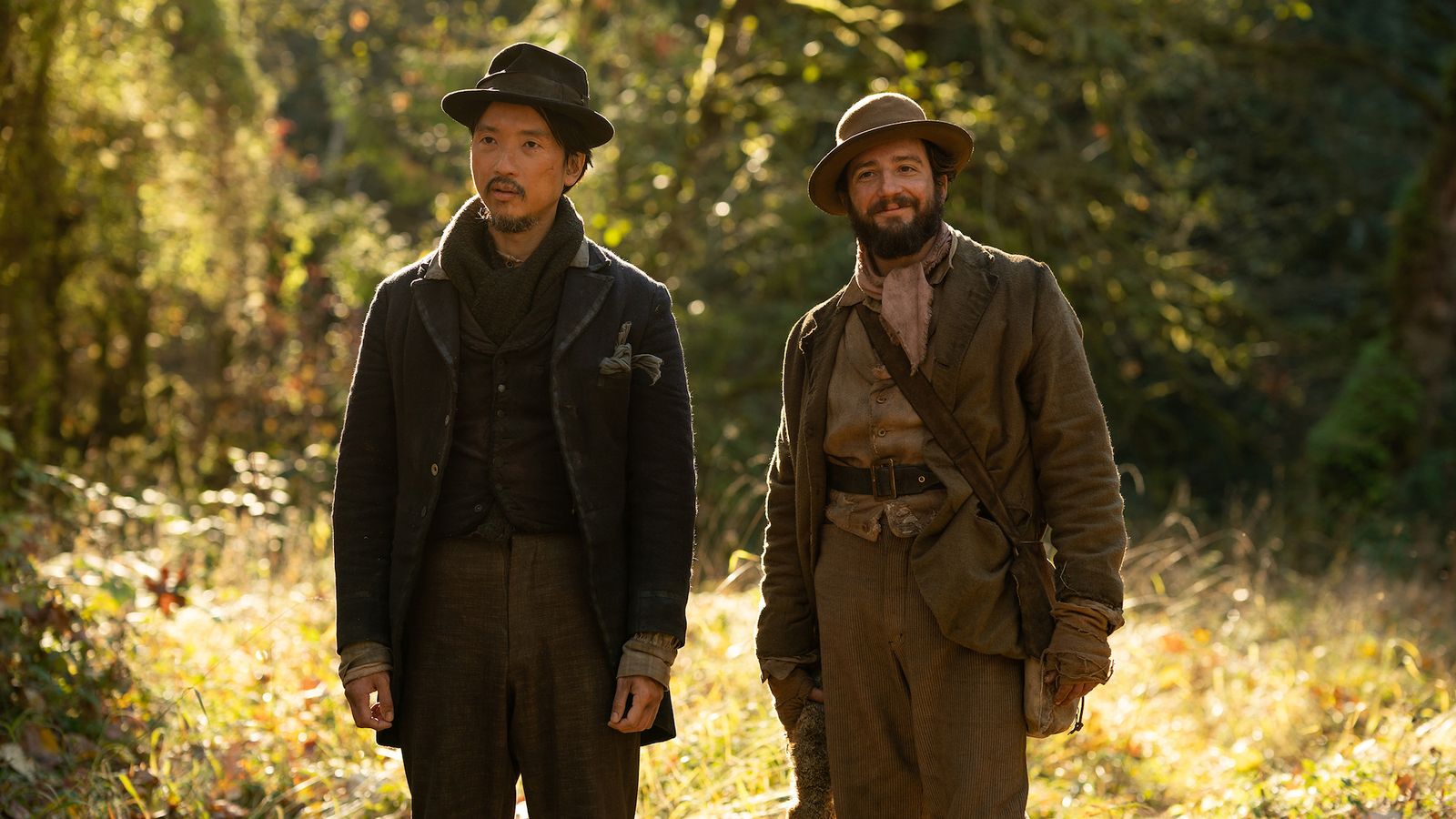
A big favourite for the Golden Bear, Kelly Reichardt’s First Cow was unfairly snubbed at the awards ceremony. It is a real shame because this was the kind of film that, for its gentleness and modesty, would have been a very fitting winner of this year’s edition of the Berlinale. First Cow could be jokingly summarised as a film about two men in the Old West living together under the same roof, making scones. Cookie is a shy young man from Maryland, while King Lu is a savvy business-minded labourer from China who has travelled the world before reaching the Oregon Trail to seek his fortune. The two men team up to share a shack in a remote settlement. The outpost is sparsely populated by brutish rogues and a pretentious English man who acts as the colony’s chief. Cookie and King Lu are the kinds of men that the cinema of the old American frontier has rarely shown us. They are gentle and reserved men, a far cry from the kind of aggressive pioneer masculinity that we have come to know through cinema history. One of the most exquisite pleasures of this film comes from the candle-lit night scenes inside the shack, Cookie and King Lu quietly busy with their domestic chores and occasionally exchanging a few words like a couple of married pensioners. They could be lovers but there is no evidence of any romantic feelings between them, only kindness and mutually supportive comradeship. It feels as though, with this film, Reichardt wants to rewrite a foundational American story, inviting us to imagine an alternative genealogy of US masculinity, one based on cooperation and resourcefulness, rather than aggressive individualism and competitiveness
For me, the third and final highlight of this year’s Berlinale was Hidden Away, Giorgio Diritti’s magnificent biopic on Italian artist Antonio Ligabue. The narrative arc of the film is fairly conventional. It follows Ligabue’s life from his childhood in native Switzerland, where he was put into confinement due to his mental illness, to his mature years in northern Italy. An untrained sculptor and painter, Ligabue became one of the most influential Italian artists of the 20th century. Boasting an extraordinary performance by Elio Giordano in the role of Ligabue, Hidden Away does more than simply celebrate the genius of a great artist. The film makes viewers embrace the perspective of someone who was mistreated all his life for being different, even in the face of the great admiration that his work inspired. Firmly aligned with Ligabue’s subjective experience of the world, Hidden Away attempts to articulate his unframed perspective. Signalled by frequent subjective shots conveying a blurred peripheral vision, this perspective seems to express optically the special connectedness to the world that this artist developed through his art. It is a type of connectedness which at times strikes one as primitive and unhinged, and other times appears surprisingly full of wisdom and tenderness. Giordano’s highly physical performance combines feral abruptness and child-like vulnerability. Giordano is truly magnificent at embodying the loneliness and anguish experienced by Ligabue throughout this life. Yet, this is far from a tragic story. Hidden Away is a film about an irrepressible man who has fought all his life to assert his humanity and different way of being in the world against the bigotry surrounding him.
The Golden Bear for Best Film went to There is No Evil (Mohammad Rasoulof). The full list of awards can be viewed here.
Photo Credit: Allyson Riggs via A24 Films (First Cow)