
Stunning landscapes, aching nostalgia and confronting the past at this year’s BFI London Film Festival, as reviewed by five of our writers.
THE SONG OF SCORPIONS
Dir. Anup Singh (India)
Review by SU Ahmad
Present at London’s Cine Lumiere to introduce his third feature The Song of Scorpions at the BFI London Film Festival, director Anup Singh spoke as if briefed by Paulo Coelho backstage. He remarked on the violence currently saturating our screens and asked us, the audience, whether we would “breath out the violence that we take in” or instead “breath out a song”. I wanted to ask him whether violence itself can ever be beautiful, even melodious.
Known for strong female leads, the opening scenes of Singh’s dark love story introduce us to fiercely independent Nooran, played by Iranian-born Golshifteh Farhani who learnt Hindi for the role and did an impressive job. A singer-healer taught by her grandmother, none other than Bollywood legend Waheda Rehman, Nooran goes about the Rajasthani desert coaxing scorpion venom out of bite victims with her song. Meanwhile, besotted camel herder Aadam (Irrfan Khan) has a mysterious knack for appearing by her side during her travels, remaining enraptured despite numerous humiliations.
The cinematography is stunning, with Pietro Zuercher and Carlotta Holy-Steinmen shamelessly taking advantage of Rajasthan’s golden desert and star lit night skies, frequently returning to silhouettes of veiled women navigating sand dunes in the darkness. While hauntingly beautiful, it is perhaps excessive, as if exclusively made for the pleasure of westerners lusting after a taste of the exotic.
After a well-executed Shakespearean plot twist, the story drifts off into obscurity in the second half, and will leave many frustrated. Farhani and Khan’s stellar performances, however, make The Song of Scorpions a worthwhile watch.
THE SHAPE OF WATER
Dir. Guillermo del Toro (USA)
Review by SU Ahmad
Fans of the now cult classic Pan’s Labyrinth (2006) will not be disappointed by Guillermo Del Toro’s eagerly anticipated The Shape of Water, a fantasy movie set in the Cold War era focusing around what is an MKUltra-esque government programme. The prize possession for government operatives working in a covert US military facility becomes a newly discovered humanoid creature from South America.
Director Del Toro, who recently weighed in on the Harvey Weinstein sexual abuse scandal at the BFI – “two horrible things happened in the late-nineties, my father was kidnapped and I worked with the Weinsteins” – casts Sally Hawkins as the charming Eliza, a mute cleaner who forms a relationship with the captured creature amidst its horrendous abuse, and plots a daring plan for its escape. “That thing isn’t human!” a friend bellows at her upon uncovering her plan, to which she responds in sign language, that if the creature is left to die “then neither are we”.
The political backdrop of the film highlights middle class America’s rampant racism, homophobia and xenophobia in the 1960s, themes which are integral to the film’s central message. Viewers will notice that the overall enemy in the film in many respects is the mediocre straight white all-American male, with the ‘good guys’ consisting of a motley assortment of the disabled, people of colour, the foreign, and a highly intelligent aquatic being.
To use Alfonso Cuarón’s words, “…run immediately and go see that film. It’s absolutely sublime.”
SPOOR
Dir. Agnieszka Holland (Poland)
Review by Rukiya Gadid
‘Spoor’ is an English word related to hunting, meaning to follow the tracks or scent of a person or animal. It is also the title of a beautifully made film set in the luscious green pastures on the Polish-Czech border. The film stunningly spans all four seasons and follows the tale of Janina Duszejko, an eccentric partially retired teacher, as she tries to solve murders committed in the forest where her small cabin resides.
It’s an ecological thriller written and directed by Agnieszka Holland, based on the polish novel chillingly titled Drive Your Plow Over the Bones of the Dead by Olga Tkarczuk who also co-wrote the screenplay. The film has been labelled a ‘feminist black comedy’ and the gender dynamics are fairly significant from the start, whereby a mysterious incident leads the protagonist into a direct confrontation with the police, who dismiss her concerns about her missing dogs and the all-male hunting club.
The film also explores other themes such as the fragility of life and the splendour of nature. It truly comes alive as a result of the magnificent cinematography which captures the jaw-dropping beauty of the Kłodzko Valley, and through the charismatic performance of Agnieszka Mandat who plays the lead character. Together, these redeem the film as the plot takes many odd turns which can leave you scratching your head.
ISRAFIL
Dir. Ida Panahandeh (Iran)
Review by Amir Rizwan
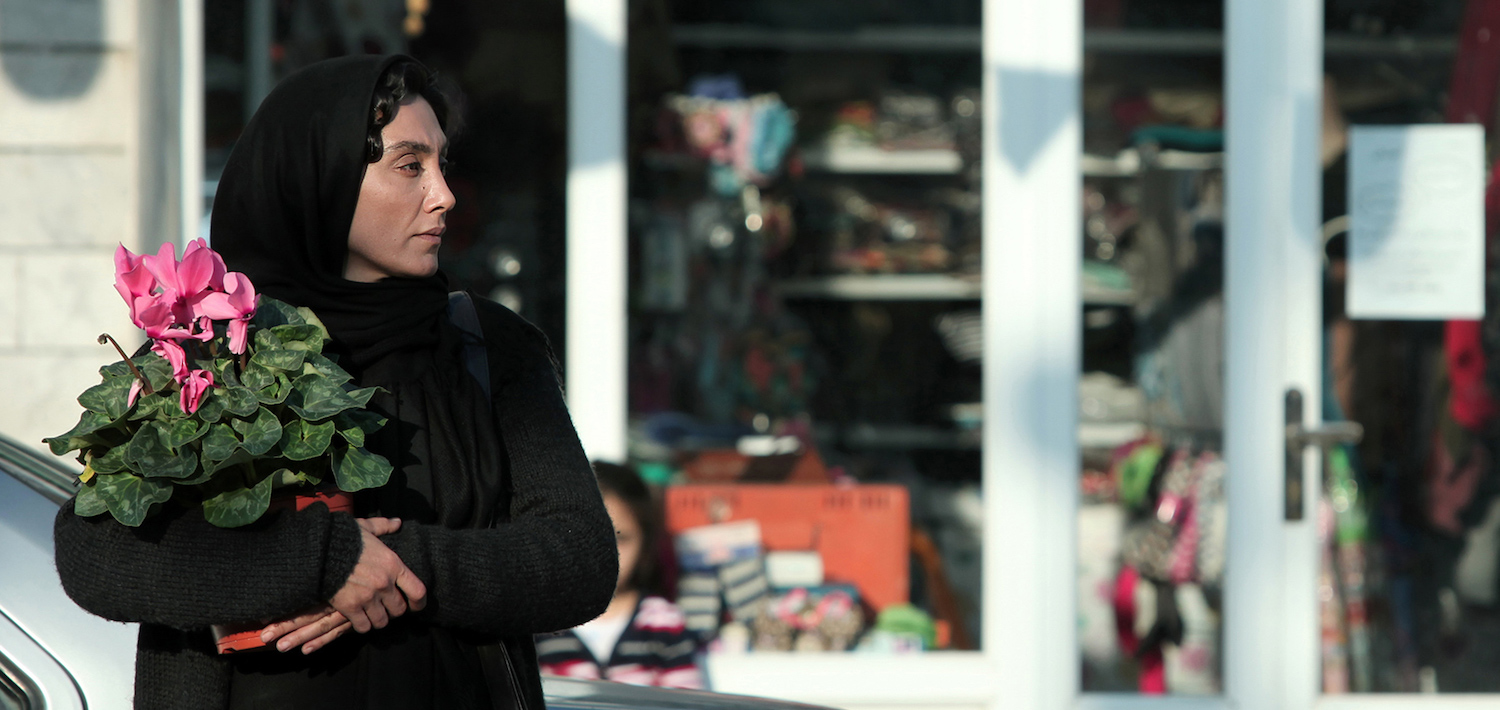
Ida Panahandeh’s Israfil puts three women at its centre. The film’s location is a small town in the Mazandaran Province in the east of the Caspian Sea, offering viewers the green, misty and irregular landscapes that provide the depth of each frame. The film begins by focusing on widow Mahi (Hedieh Tehrani) and Behrouz (Pejman Bazeghi), two former lovers whose relationship scandalises their families, and who are reunited through the death of their son. But soon the arrival of a young woman, Sara (Hoda Zeinolabedin), a love interest of Behrouz, disrupts the story. As she returns to Tehran a different story emerges – one that features a family of three in which the mother has mental health problems and an older son dreams of emigrating.
Throughout Israfil there are moments of beauty and a unsatisfied nostalgia for the past which elicits moments of sadness – whether that is through the broken gaze of Mahi or the tone of Behrouz when he calls Mahi’s name affectionately for the first time. One of the most enjoyable aspects of this film was the gradual and subtle creation of a world brimming with emotion. No shot feels arbitrary. The movie is abound with visual sophistication ensuring that behind every image there remains feelings of closeness, death and sorrow.
ADRIANA’S PACT
Dir. Lissette Orozco (Chile)
Review by Zainab Rahim
Adriana’s Pact is a series of chilling interviews conducted by director Lissette Orozco, who is trying to find out whether her ‘favourite’ aunt was a torturer under Augusto Pinochet. Confessing to being swept off her feet by the privileges of the high ranks, Adriana only agrees to participating in this film because she believes it will clear her name. Instead, through the calmly determined character of Orozco, a story of scandal, denial and hysteria unravels on screen – and it feels like it’s happening in real time.
Orozco must be highly commended for her raw and incredibly brave debut documentary film that digs deep into her family’s history. She told the BFI audience that she pressed on with the making of the film for years, despite losing key funding and at the harsh disapproval of a number of family members. The skilful angles and editing make for unsettling viewing. It will particularly resonate with those who can relate to the murky aftermath of brutal dictatorships (for me, Adriana was a straight comparison with Baathist intelligence workers under Saddam’s mukhabaraat), where troubling testimonies emerge from the woodwork, competing to be heard.
THE JOURNEY
Dir. Mohamed J. Al-Daradji (Iraq)
Review by Zainab Rahim
Baghdad has a thousand and one tales to be told in a suffering cultural industry. That’s where Mohamed J. Al-Daradji steps in. Being one of few Iraqi filmmakers to reach international acclaim, Al-Daradji has worked tirelessly to train non-professional casts and crews from scratch.
The Journey follows aspiring suicide bomber, Sara, on a tense 24 hours in Baghdad Central train station on the day of its re-opening. Though fictional, it succeeds in introducing a fractured and diverse cross-section of Iraqi society through its characters: orphaned children, aggressive yet endearing, selling roses; an elderly father reading the Qur’an over the coffin of his son; a mother who abandons her baby for fear of shame; a bride-to-be who is being sent to Basra; and a busker who cannot afford to marry his sweetheart.
Though insurgency in Iraq is often attributed to ‘foreigners’, Sara’s Iraqi accent is uncomfortably familiar – and her weary bitterness even more so. Al-Daradji intentionally leaves out her background and motive, instead humanising her by weaving her experiences with that of others. Does she press the button? You’ll have to watch it to find out. Aside from a few stiff performances (understandably) and some unconvincing bonding between the protagonists, The Journey manages to represent a microcosm of the traumatised state of a nation. The film still needs a distributor and thoroughly deserves one.
THOROUGHBREDS
Dir. Cory Finley (USA)
Review by Louis Bayman
There can be something truly endearing about wickedness, so long as it is done with consistency. And you will find no film more consistent than this tight, eccentric thriller and its teenage evildoers. Everything in it has the controlled energy of a ticking bomb, from the metronome regularity of the soundtrack to the enclosed decadence of their LA mansion – part prison, part palace – where the two playmates languish indoors over long sunny days, as fantasies of murder overtake their domestic boredom. The plot is simple enough – one rich girl with no friends is invited to a second rich girl’s house. Although she already knows that her mother is paying the second girl to befriend her, they bond over a common plan to do violence to the second girl’s new stepfather. Rarely do teen noirs come as good as this, nor as convincing, for the deliberate artifice of the heightened style fits a world of the idle rich bereft of fellow human feeling. Bearing in mind that children already occupy a position unnervingly balanced between innocence and amorality, we may say that when they’re good, these girls are very good, but when they’re bad they’re better. And at the end of it all, their wickedness almost turns into a touchingly romantic perversity.
APOSTASY
Dir. Daniel Kokotajlo (UK)
Review by Louis Bayman
The first feature for director Daniel Kokotajlo is set amongst the congregation of the Oldham Jehovah’s Witnesses, as a mother of unwavering faith faces the loss of both her children. The all-male church elders instruct her to cast out one daughter who has fallen pregnant out of wedlock, while her second must forego life-saving medical treatment due to the Witnesses’ embargo on blood transfusions. Belief requires faith; commitment is tested by sacrifice. But how, when the sacrifice is yours, can you really know you have not adhered to a false doctrine? The sociologist Max Weber distinguished between ‘church’, which encompasses all those born in a community, and ‘sect’, which includes only the elect few, whose righteousness is proven against the mockery of the heathen majority. Films and documentaries that try to denounce the strange habits of sects and cults can themselves have a bit of a tendency to preach to the converted: that is, they shine a spotlight on the exotic crazies at the margins to reassure the general audience in holding the beliefs of the majority. Nevertheless, this is an enlightening glimpse into a minority religion and a sensitive portrayal of a woman caught between closeness to her religious community and to the family with which it is at odds.
Amir Rizwan works in the social investment space supporting high impact social enterprises and charities.
Louis Bayman is film editor at The Platform and an academic based at the University of Southampton.
Rukiya Gadid is a writer on society and culture in the big city.
S U Ahmad is a London-based editor and contributor here at The Platform.
Zainab Rahim is the joint editor-in-chief of The Platform.
Photo Credit: Israfil / Omid Salehi