The perspective
As the US Africa Command expands operations, the geographic focus of Islamophobic rhetoric and immigration restrictions will follow suit.
As the US Africa Command expands operations, the geographic focus of Islamophobic rhetoric and immigration restrictions will follow suit.
In early January, Donald Trump once again managed to top his own record of offensive vitriol when he referred to Haiti, El Salvador, and the entirety of the African continent as “shithole countries.” He was having a conversation with lawmakers about a potential bipartisan immigration deal, including protection for vulnerable immigrant populations, when he made the racist comment. His ensuing remarks further underlined the economic logic behind his words, when he opined that the United States should solicit more immigrants from “places like Norway” and that Asian immigrants were more likely to bolster the country’s economy. In other words, Trump values immigrants according to their capitalist potential to bolster white supremacist American capitalism: if they don’t make the country whiter, then they at least have to make the white elite richer.
On the surface, Trump’s racist finger-pointing at African and Latin American populations as hailing from “shithole countries” doesn’t seem connected to the Islamophobic fearmongering we associate with the Muslim Ban, which primarily targets Arab countries. However, the shifting of the Muslim Ban country list westwards into central Africa has created a direct geographical overlap between the seemingly separate strands of xenophobia.
This geographic overlap opens our eyes to the shared economic agenda behind the racist “shithole” comment and the Islamophobia of the Muslim Ban: in its essence, the Muslim Ban is just another mechanism for excluding people from countries that have borne the brunt of economic exploitation under the capitalist world system. Trump’s “shithole” comment reveals the core capitalist logic that both created and sustains American white supremacy. In what follows, I give some more background on the Muslim Ban and explain how its pivot westwards into central Africa signals an age-old process whereby countries are economically exploited, politically repressed, criminalised on an international scale, and then banned.
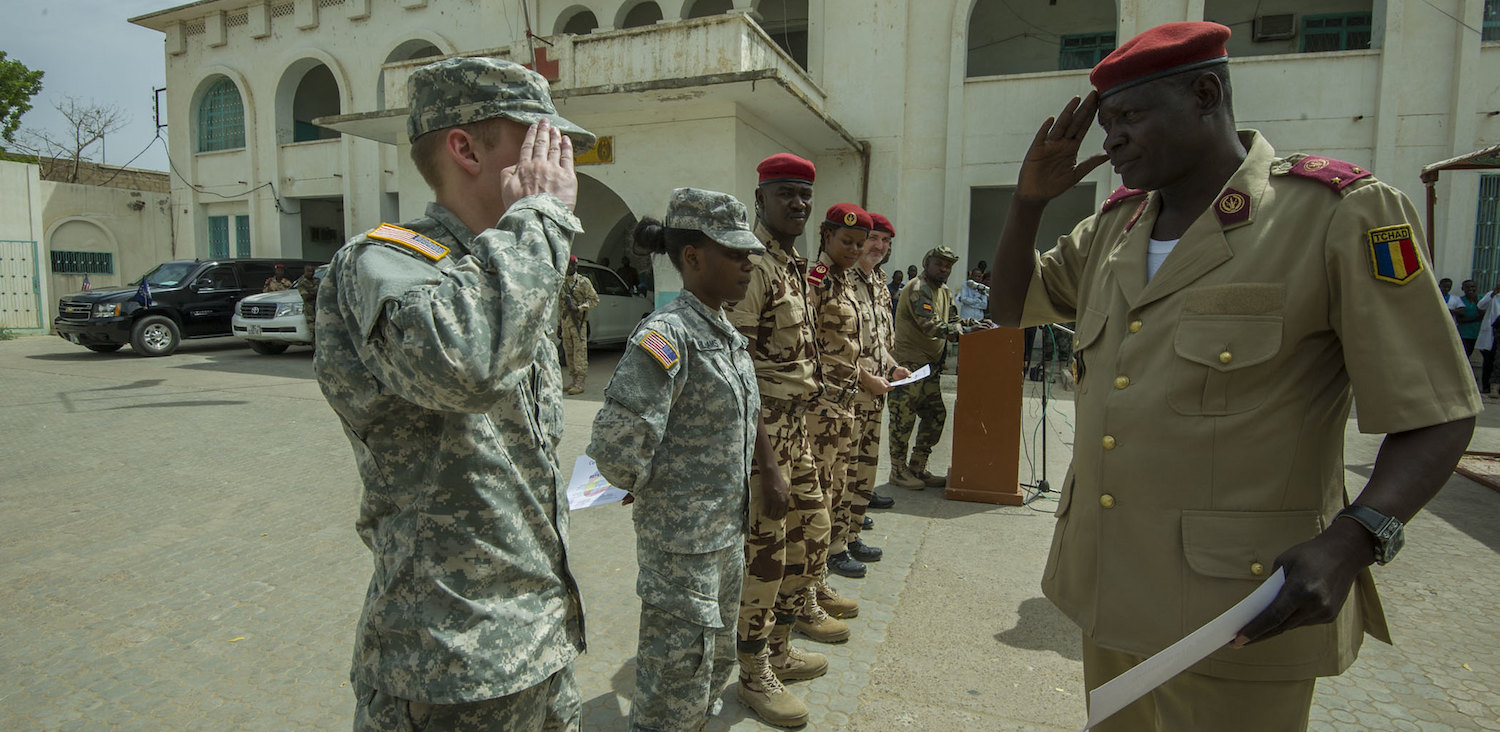
In late September of last year, the Trump administration announced its third version of the “travel ban,” more accurately dubbed “Muslim Ban 3.0” by protestors. The first version blocked immigrants from Iraq, Syria, Iran, Libya, Somalia, Sudan and Yemen, as well as refugees from Syria. The second version removed Iraq from the list. The third version then removed Sudan, but added its Saharan neighbor Chad. Just one week later, four US soldiers were killed in Niger, the country located just west of Chad: the soldiers were not killed in response to the ban, but the close timing of the two events is not exactly a coincidence either, given the recent timeline of American military activity in the region and its political context.
Both the ban on Chad and the presence of US special operations military forces in Niger are indicative of a larger trend in which the geographical apex of American intervention is increasingly shifting towards Central and West Africa – specifically the Lake Chad Basin and greater Sahel. This trend traces back to the Obama administration in 2008, when the US Africa Command (Africom) was created to confront Al-Qaeda in northern Africa. Africom subsequently played a role in the Libya crisis. By 2014, the US had trained and equiped counterterrorism units in Libya, Mali, Mauritania, and Niger; that year, Obama asked Congress for $5 billion more to expand operations. As of 2018, there are US drone bases, security coordination arrangements, weapons conduits and special operations forces across the region. Despite this, their presence remains opaque and journalists have struggled to gain access to even the most basic information, like lists of base locations.
The soldiers’ deaths in Niger thus came as a surprise to the American public. Elected officials from both political parties were likewise unprepared for the news, claiming that Congress has been kept in the dark about the extent of special operations in the region. Media quoted a number of politicians sternly announcing their intent to investigate the situation. However, they seemed more upset over their political exclusion than the violence clearly escalating in Niger. For example, Senator Lindsey Graham condemned the secrecy but embraced the expansion of violence, explicitly condoning increased military operations in Africa and more lax criteria for kill strikes.
But has Congress actually been excluded from the long years of warmongering that brought us to this point? In 2002, Senate voted overwhelmingly for the post-9/11 “Authorisation of Military Force” bill that gives the military a carte blanche to secretly send the Armed Forces anywhere and everywhere in the name of the War on Terror. In September 2017, mere weeks before the Muslim Ban 3.0 was announced and the soldiers were ambushed in Niger, Senate voted 2:1 to reject an amendment designed to revoke the authorisation.
Furthermore, Congress is deeply complicit in the Libya crisis that precipitated the current surge of violence in the Sahel region. With US support, NATO imposed its no-fly zone on the same day that African Union leaders were slated to fly in to Libya and negotiate the terms of a peaceful transition with both Qaddafi and the opposition government. The immensity of this thwarted moment in Pan-African diplomacy would become painfully clear over the following two years, as multilateral war erupted in Libya and spilled over the border into Mali. The flood of arms from Libya to neighboring Sahel states enabled Boko Haram – a militant organisation in northern Nigeria – to rapidly expand across the Lake Chad basin between 2012 and 2014. Since May 2013, the conflict between Boko Haram and Nigerian security forces has displaced 2.3 million people, with at least 250,000 fleeing Nigeria for Cameroon, Chad and Niger.
All of this is to say that the current US presence in Chad and Niger is just the latest episode of post-9/11 American interventionism. In a recent New Yorker article, journalist Ben Taub describes a pattern in which the United States backs a repressive government like that of Chad’s President Déby in the name of stability, but in doing so actually exacerbates the conditions of social breakdown and support for armed groups. Kenyan writer Nanjala Nyabola concurs: “In the name of this ‘Stability Doctrine’, foreign governments… bolster the short-term status quo, even if that means disregarding visible discontent and overlooking state abuses. They pick power over protesters.”
Given that the UN is currently providing aid to those displaced, Taub argues that people have come to rely on conflict as the only consistent cash cow in a region where fishing and agriculture has been decimated by climate change. He writes, “Travelling through the Lake Region, I got the impression that almost everyone there—and especially those in the Presidential palace—has a stake in Boko Haram’s continued existence as a distant, manageable threat.”
In conclusion, Chad is not on the Muslim Ban 3.0 list because it’s a “state sponsor of terror.” On the contrary, it is one of the United States’ most steady allies in the region, currently hosting a major base camp for drone operations. While the exact reasons for its inclusion on the list have not been publicly confirmed, it seems that certain factors are preventing Chad from adequately screening its citizens before issuing travel documents. According to a 2017 report by Amnesty International, over the past year Chad has cut civil society and army wages, sparking widespread protest followed by a wave of state repression and incarceration of human rights activists. Essentially, in a strong-man security state, everyone beyond the government is suspect: if stability is bought, then the officials who line their pockets are the only ones with stable loyalty.
From this perspective, the Muslim Ban has come to its fullest bipartisan, capitalist expression by banning immigrants from Chad, a country whose people successfully staged a national strike in 2016 to protest their president and to demand a constitution. If there is one thing the American empire despises more than terrorism, it’s the thought that African people might get free and throw a wrench in the corporate plunder of their continent.
If there is one thing the American empire despises more than terrorism, it’s the thought that African people might get free and throw a wrench in the corporate plunder of their continent.
In fact, African organising has the potential to not just uplift African people, but also to halt the destruction that fossil fuels and weapons industries inflict on all of us, all around the globe. Numerous powerful countries are setting their sights on Africa right now because the continent has a vast untapped resource base: will those riches be dedicated towards the sustainable development of the continent, or will they be siphoned off to sustain American polluters and weapons manufacturers?
As Pan-African community leader Ahjamu Umi wrote about local resistance in both Chad and Niger: “People in the US are programmed to view the US as the centre and initiator of everything in the world. The truth couldn’t be farther from that. These uprisings in Africa are the current steps towards fighting for one unified socialist Africa to cement the final battle against imperialism on the world stage.”
The silver lining of Chad’s addition to the Muslim Ban is quite literally putting Chad on the radar of international solidarity, prompting students like myself to ask questions and look for answers. Now that we are increasingly connecting the dots between Western military intervention, extraction industries, autocratic national elite, the making of “shithole countries” and immigration policy, I hope this understanding will translate into more effective organising that recognises the shared economic roots of both domestic xenophobia and international imperialism.
An earlier version of this article appeared in the March-April 2018/1439 edition of Islamic Horizons, a quarterly magazine published by the Islamic Society of North America.
Photo Credit: US Army Africa / Shejal Pulivarti via Flickr