
Ayse Toprak’s award-winning film complicates our understanding of both the refugee crisis and LGBT human rights movements.
Directed by Turkish filmmaker Ayse Toprak, the documentary Mr Gay Syria follows activist and journalist Mahmoud Hassino and some of the members of the Istanbul-based Syrian LGBT group ‘Tea and Talk’ as they prepare for the competition that will send the first Syrian delegate to the 2016 Mr Gay World contest in Malta. As the representative of the diasporic community of gay Syrians who escaped their homes when the war broke out in 2011, Mr Gay Syria – we learn – will be the only refugee competing for Mr Gay World.
The expedience of the Mr Gay World contest allows for the initial building up of a narrative of hope: we learn that the winner will go to Malta and then, maybe, will get a VISA to live and work in Europe; maybe he will find a boyfriend there and get married, one of the organisers says with a smile. The plan to send a Syrian to Mr Gay World with the objective of making LGBT refugees more visible internationally mirrors the way in which the documentary itself aspires to engage a global audience to convey its message. A Turkish-German-French co-production, Toprak’s film has been shown in over 55 international film festivals (winning 11 awards) but cannot yet have national distribution in Turkey, and it is unlikely it will be shown in Syria in the foreseeable future.
At one point in the documentary, Hassino explains the reason why he decided to organise the Mr Gay Syria contest: “It’s to change perception. The only image of gay Syrians [we have] is given by ISIS.” Hassino is referring to the horrific videos showing ISIS jihadists throwing several gay men off rooftops during the Syrian war. Far from simply shying away from this human tragedy, he insists on the need to substitute this array of deathly images with one of queer resilience and survival. As Toprak explains in an interview, Hassino “wanted the world to know about the living gay Syrians, not just the dead ones”. Hassino’s desire speaks to the kind of demand for recognition that Mr Gay Syria makes to its viewers, one that asks us to replace the depersonalised, anonymous image of the refugee that our contemporary media culture has fed us with real faces and life stories. It is an endeavour that comes with some costs, especially for the individuals who decide to share with us the pain of forced migration and the difficulty of living in homophobic societies. While revealing some of the challenges that these individuals face with their families and communities following their decision to appear in the film, the documentary gives voice to their shared determination to fight back.
For Philosopher Giorgio Agamben, the figure of the refugee forces us to abandon the concepts through which we have so far represented the subjects of political life (citizen, sovereign people). In his essay ‘Beyond Human Rights’, Agamben refers to the first article of the Universal Declaration of Human Rights: ‘All human beings are born free and equal in dignity and rights […].’ While the article refers to all human beings, Agamben notes that the case of the refugee shows that human rights are not compatible to the mere condition of being alive. Although refugees are living beings, they do not automatically have access to the same rights as most of the citizens of a nation state, having to undergo assessments by immigration and naturalisation services intended to turn them into citizens. As the figure that should more than any other embody the notion of human rights, the refugee marks in fact the radical crisis of a notion that has been imbricated since its conception with the paradigm of the nation-state and the notion of nativity.
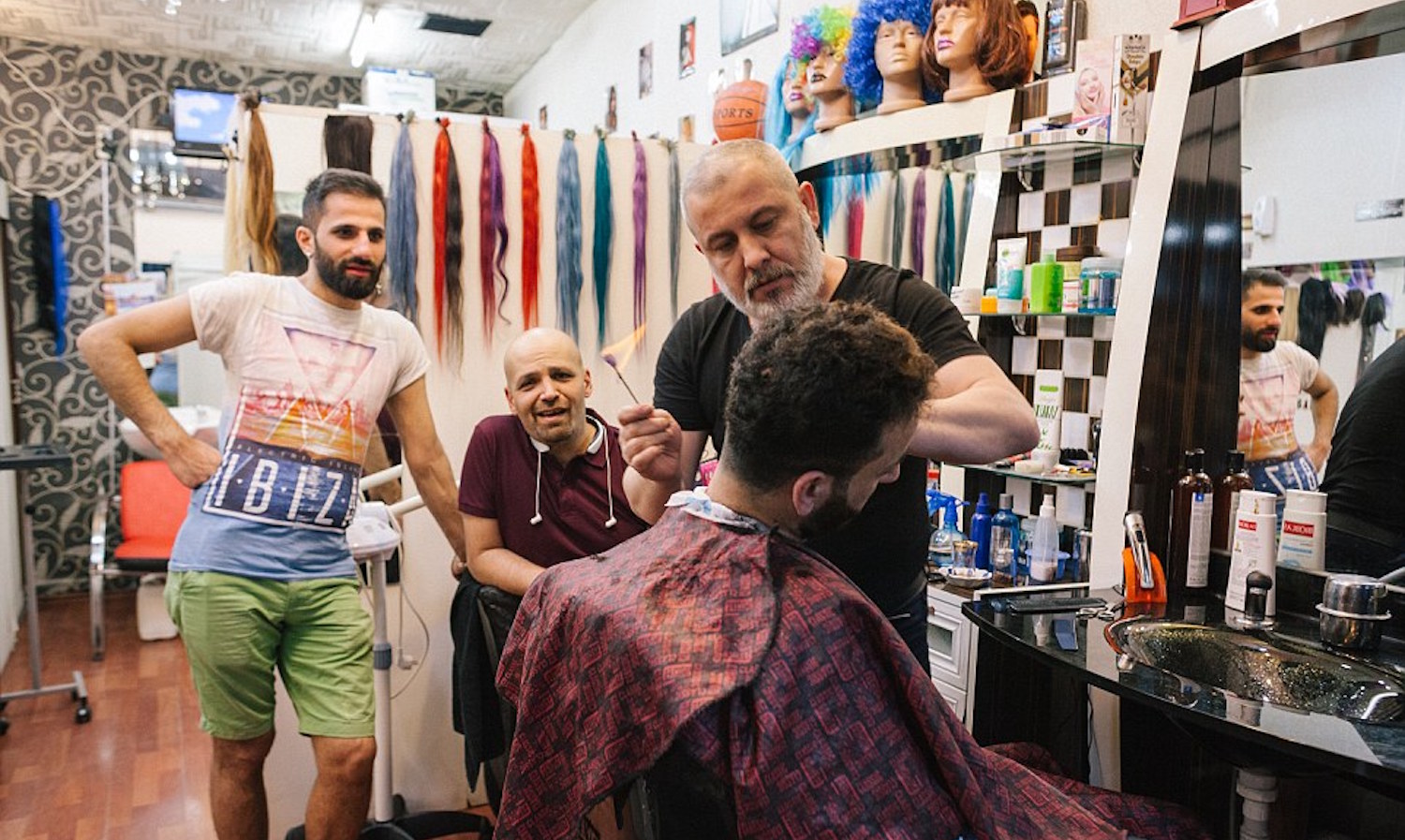
Considering the current plight of migrants trying to cross the Mediterranean and the inhumane response of many European nations to the current refugee crisis, it is hard not to take Agamben’s point seriously. Mr Gay Syria complicates this point by showing the ways in which the predicament of LGBT refugees fleeing war-torn Syria may shed light on some of the limitations of the much celebrated rise of a globalised LGBT political culture and its human rights agenda. A 24-year-old barber who fled Syrian, Hussein is the documentary’s main character who will eventually win the Mr Gay Syria title. Things turn out differently from what one might expect. Hussein has to endure a strenuous visa application process to see if he can travel to Malta. Mr Gay Syria ends up shedding light on some of the hypocrisies underlying the seemingly inclusive agenda of global LGBT brands such as Mr Gay World and their commitment to fight for the human rights of LGBT people around the world.
Through the focus on Hussein and the singularity of its title, Mr Gay Syria may seem initially invested in a narrative of queer politics that privileges the individual, one in which only one can win (and go to Mr Gay World), leaving others behind. This is where the film most surprises, allowing us to get to know a resilient network of friends, activists and lovers who appear deeply invested in collective practices of political action and mutual support.
On stage, Hussain wins the Mr Gay Syria’s competition with a moving monologue in which he talks to his mother about the hatred he has faced through his young life. For this monologue, Hussein kneels in front of an empty chair. It is an evocative image that relates to another heavy absence within the film: the country that these refugees clearly love, from which they have been forced to escape. Throughout the film, we never see the Syria that Hussein and his friends sorely miss. At the beginning and at the end of the film, Hussein sits on a roadside facing the Turkish-Syrian border. We see him looking ahead. Yet, as we are prompted to pay attention to his gaze, we don’t see what he is looking at. Evoked through the off-screen space, this painful absence haunts our viewing experience: maybe as a call to see beyond our restricted horizons?
In the ‘Beyond Human Rights’ essay, Agamben sees the refugee as a paradigmatic figure from which we should start re-thinking politics and a future ‘political community’ in radical ways. With the number of refugees and migrants forced to leave their countries increasing in the last few years (it is estimated that 3,500 queer refugees currently live in Berlin alone), films such as Mr Gay Syria ask us to also re-think the meaning of LGBT politics and the scope of queer film culture.
Photo Credit: Mr Gay Syria (dir. Ayse Toprak)