Netflix horror ‘The Platform’ directed by Galder Gaztelu-Urrutia shows us the ugly face of class and capitalism.
* Contains mild spoilers
During a period of bleak uncertainty, where life as we know it is transforming into a kind of dystopian horror, Spanish director Galder Gaztelu-Urrutia does not seek to offer a comforting hand – but instead holds up a mirror to our society of greed. I am referring to his recent thriller The Platform, added to Netflix at the beginning of March this year, where Gaztelu-Urrutia delivers a sickening commentary on class structure and mankind’s insatiable appetite in this horror feast.
When our lead character, Goreng (Ivan Massagué) wakes up to find himself in a vertical prison of incalculable levels, he is horrified to discover the only form of nourishment is an extravagant banquet, travelling down the tower of two-person cells on a platform. The horror derives from the concept of equal distribution, seemingly non-existent within these concrete walls, as the prisoners on the upper levels indulge leaving the victims of the lower levels to starve. Goreng hopes to change the injustice that permeates the prison, but soon discovers that our selfish instincts are a lot harder to tame than he expected.
Gaztelu-Urrutia’s concept is a disturbing illustration of class structure for the senses and certainly entices audiences to question the morality of such practices. Its premise is, of course, bizarre and barbaric but also incredibly accurate. A fundamental flaw of the universal class system is its entitlement, mirrored perfectly by Gaztelu-Urrutia’s storytelling, as this prison’s occupants do not earn their place at the highest level but are merely placed there. Those at the top behave with hostility and have little respect for those below them, their gluttony draining the food from the platform and their contempt showering the remaining scraps with their own bodily fluids. This metaphor carries a horrifying depiction of a reality steeped in classism and unjust privilege.
Writers David Desola and Pedro Rivero make certain we understand the important messages which echo our current civilisation with their ‘matter of fact’ scriptwriting. The moral of the film is encapsulated entirely in one particular piece of dialogue when Goreng’s fellow inmate Imoguiri (Antonia San Juan) states, “if everybody ate only what they needed, the food would get to the lowest level.” This allegory is about as subtle as a brick through a window, and in fact arrives like a perfect accident, as the film was in development long before the stockpiling and panic buying that hit the UK in March during the escalation of the coronavirus pandemic, illustrating that the world needs to listen to these lessons now more than ever.
The fact the themes of the film are in plain sight points to cinema’s freedom to address issues that many choose to turn a blind eye to. Although the script could have benefitted from more subtlety in order to encourage moral contemplation, The Platform’s lack of restraint holds our attention and lends itself perfectly to Netflix. Gaztelu-Urrutia uses this film as a soapbox at a time when society is fixed in its traditional class structure. Gaztelu-Urrutia excels in providing a clear and frank visualisation of our own selfishness. The nauseating visuals and stomach-turning sound design are enough to make audiences think twice about stockpiling food, as they will lose their appetite within the first five minutes of the film. This caricature of the survival instinct uncomfortably displays the type of class entitlement we see every day on the news.
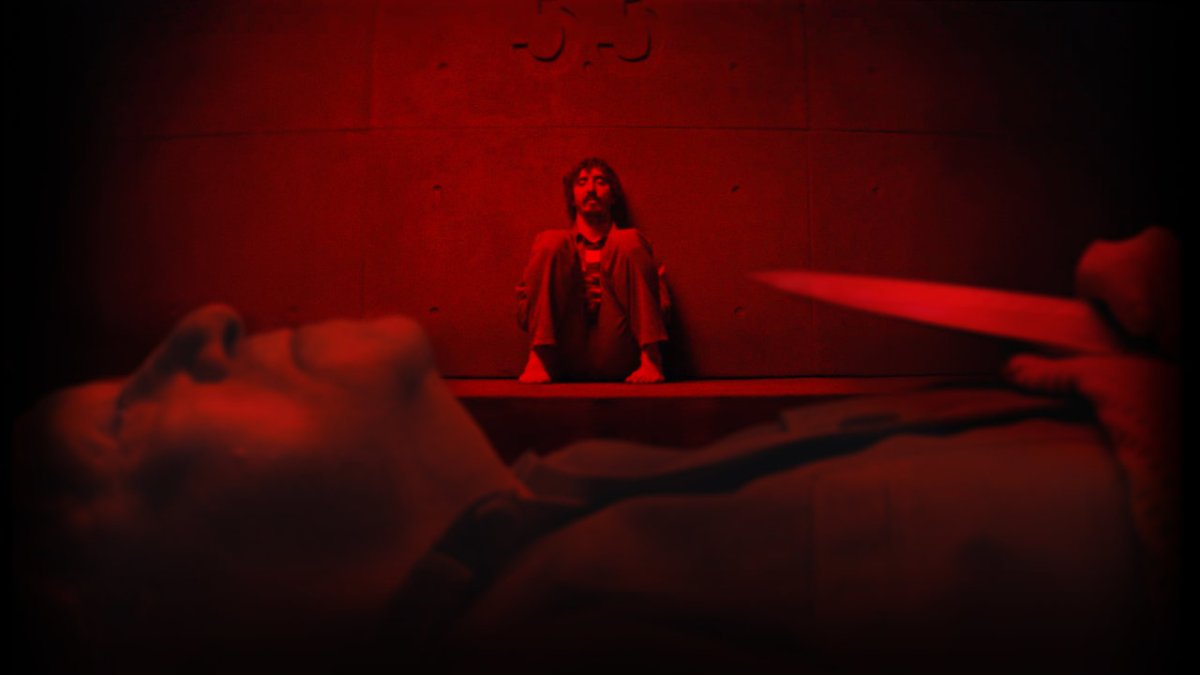
The film’s messages aren’t the only thing lacking subtlety in this fever dream thriller. Gaztelu-Urrutia and his crew effectively convey anxiety and dread through a claustrophobic set design and invasive cinematography. One of the most striking attributes is the film’s dramatic lighting changes, where at times we are engulfed in a sea of red, reminiscent of the Italian Giallo horror which seeks to conjure feelings of unease and paranoia through its colour palette. The theme of decay is also made prevalent through other aesthetic choices, the many close-ups of food that feature throughout alluding to abandoned war zones and decomposing landscapes, illustrating the repercussions of our own self-interest. Even shots of life are muted with a dull hue, as a close-up of Goreng’s eye at the very beginning of the film hints at a loss of spirit in its lack of colour and depth. The Platform’s attention to detail achieves multiple atmospheres and spaces while being restricted to the same four walls. The cast, particularly Massagué and Zorion Eguileor, seem anything but trapped, as their performances are powerful and their chemistry palpable.
Without giving too much away, The Platform’s conclusion probably asks more questions than it answers. Although it gives audiences the freedom of interpretation it also seems a lacklustre ending to an intense narrative. No one could accuse the ending of being predictable, but it is not fully satisfying and left me feeling hungry for more. It seems Gaztelu-Urrutia sends a message that is not quite as bleak, hinting at a chance of redemption for humanity and providing a portal to a less hostile and selfish world, if only its citizens can find the key to unlock it.
The Platform perfectly utilises sensory horror and explicit gore to communicate its all too relevant messages. It projects an ugly side of humanity, leaving it to rot on screen, until it leaves a bad taste in your mouth. This is until the film’s conclusion where audiences are given the freedom to write their own ending. At such a desperate point in history, we need to see this film as a turning point for our attitudes towards class, privilege and entitlement, and remedy the problems they cause through mutual kindness and respect for one another, regardless of the level we find ourselves on.
Photo Credit: The Platform film / Netflix