The perspective
An effort to portray accountability for torture in Scott Z. Burns’ new film is undercut by the silencing of the victims themselves.
An effort to portray accountability for torture in Scott Z. Burns’ new film is undercut by the silencing of the victims themselves.
*Contains spoilers
In 1963 Abraham B. Yehoshua — often dubbed the Israeli Faulkner — published a subversive short story titled Facing the Forests (Mool Ha’yearot). He tells the story of a young frustrated Israeli graduate student who decides to take up a job as a fire watcher in one of Israel’s forests, and soon finds that it is inhabited by a mute Arab and an Arab child — both of whom he befriends. One day, a group of hitchhikers pass by the forest asking him for directions to an Arab village. That’s when he quickly discovers that this forest was once an Arab village seized in 1948.
The short story goes on to reveal how the village had been turned into a forest to alter the geography of the land and to erase the memory of the Arab inhabitants that once lived there. The young watchman concludes that the forest must be burnt down to resurrect the remains of this village, so on the last day of his assignment, the protagonist prompts the mute Arab to burn the forest. Beyond the smoke, the remnants of the Arab village appear, as do all things past and all things buried. The authorities rush to the scene of the fire, and the Israeli protagonist, dumbfounded, points to the mute Arab. He alone carries all the blame.
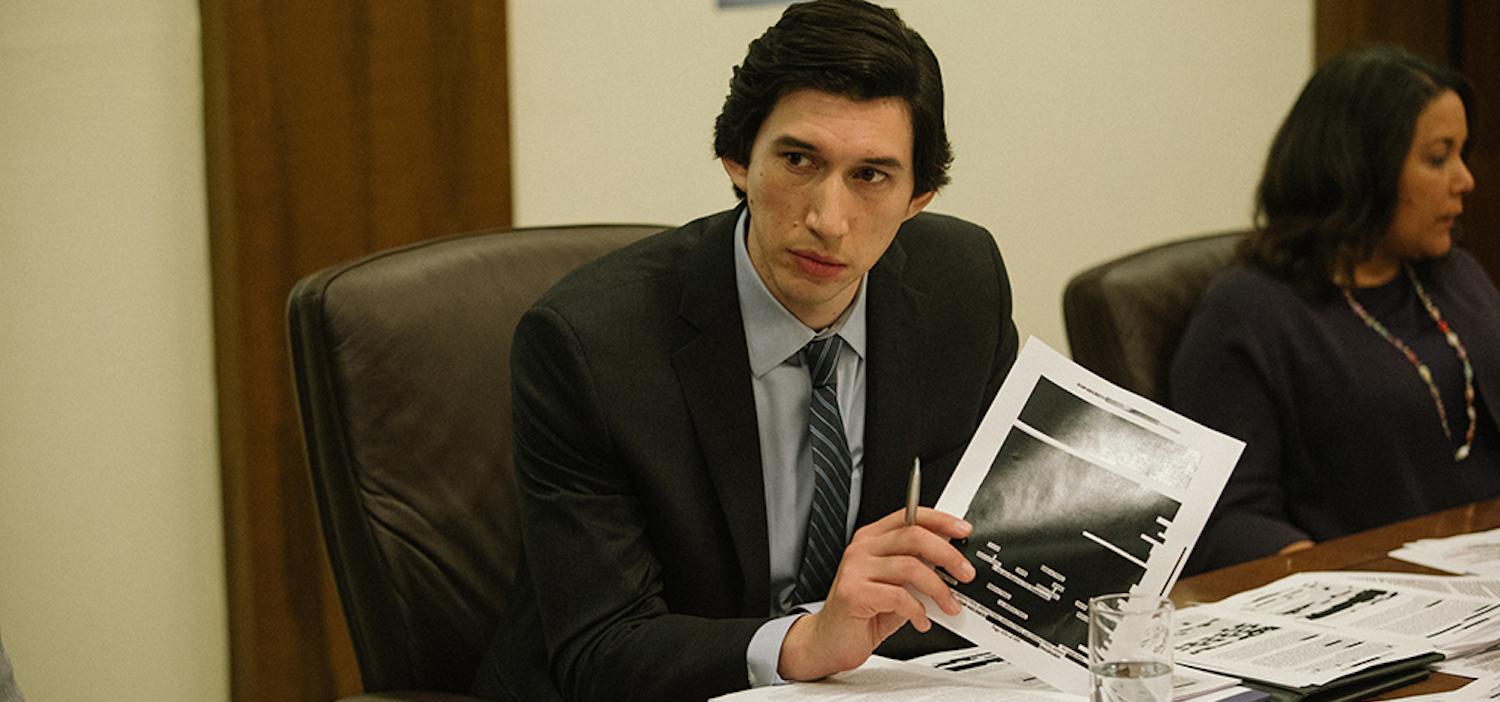
Last week, a friend invited me to go watch The Report directed by Scott Z. Burns as a part of the BFI London Film Festival. The film follows the true story of the protagonist, Daniel Jones, a staffer in the Senate Intelligence Committee, who conducted an investigation on behalf of the senate on the CIA’s ‘enhanced interrogation programs’ (i.e. torture). The story tells a harrowing story of Jones’ attempts to get his 7000-page report released to the public and the CIA’s attempts to squash and intimidate him. After a decade of hard work and despite the intimidation tactics, Jones was able to release a 400-page abridged version to the public in the ‘right way’. As the protagonist affirms in the film, unlike Snowdon, he can either do it the right way or he has failed. After the report is released, the senators applaud American values of accountability and democracy.
Granted, this is in no way an attempt to undermine Jones’ work or even the film for that matter. Jones did spend a decade of his life fighting for accountability for profoundly horrific crimes. Nonetheless, something was troubling about The Report. The same thing that makes Platoon (1986) and virtually any American film against the Vietnam War deeply uncomfortable; it is the same trope magnified in Yehoshua’s short story mentioned above. Who gets to speak? And who is forever mute? How do these scenes of torture or genocide forever doom the victims to an existential silence? It is not merely a question of scope but a constant absent present. Scene after scene displayed different and exchangeable brown bodies battered, waterboarded, beaten up, tortured, and killed. They have no features and no stories; they are simply naked and helpless bodies. Except for their screams, they are silent. Almost a mise-en-scène, each torture scene is used to contextualise Jones’ frustration or the CIA’s strategy making. Just as the My Lai massacre served to contextualise Charlie Sheen’s own crisis of conscious in Platoon.
Scene after scene displayed different and exchangeable brown bodies battered, waterboarded, beaten up, tortured, and killed. They have no features and no stories; they are simply naked and helpless bodies. Except for their screams, they are silent.
In this film, Jones states the most important fact for him and for the viewers over and over is – torture does not work. Torture is a bad strategy. It is quite likely that over 25% of those tortured were innocent. However, this review is to make a point beyond the film and beyond Daniel Jones as a character in the film or as a person. The mute victim has no story. The mute victim has no family or loved ones. The mute victim feels no pain and does not experience injustice.
We have somehow made images of a faceless naked man gagged and waterboarded into a story of our principles or ideals. Their screams are moral and ethical dilemmas that can either affirm or negate what we think about ourselves. They remain mute because the only stories we choose to tell are always about us. Will we live up to the heroic ideal of democracy we believe to embody? Or will we let ourselves down in our own eyes? And so, when Jones then allows for a semblance of accountability, somehow the moral order is restored, and we can once again celebrate American democracy. Just as the protagonist in Yehoshua’s story felt that the artificial forest threatened the myth of creation that he was made to believe. It tugged at his conscience because it didn’t live up to his ideals. And in that story, too, the mute Arab bears the consequences in the end.
Survivors of torture are made to negotiate their humanity daily. For those who got out and were able to share their stories, society advocates and even expects them to box their experiences and frame them as ‘why this is bad politics’ or ‘what does this mean for society’s ethical values?’ It is very disturbing once you sit down and hear the accounts of survivors of torture. The only way society allows for them to tell their stories is when they are not in it, their pain is abstract, their families do not exist, their voices do not exist, and only the ethical hypothetical needs to be answered. And by this, thousands of well-meaning liberal novels, stories, media reports and movies have allowed us to be the villains and heroes of the story.
The Report is on release at UK cinemas from November 2019.
Photo Credit: The Report / BFI