
The perspective
How attention to space, place and absence might structure a movement
How attention to space, place and absence might structure a movement
Nearly four months later, I am still trying to get my head around the national ‘Women’s March’ in Washington, D.C. My aim here is constructive rather than destructive. I push these words into the world not to shame those who marched with enthusiasm, but out of love for those who marched with mixed feelings – or who refused to march altogether. I believe that critiques of the Women’s March are its most important legacy, and our key to understanding what kind of work the liberation of all women truly requires. Since the Women’s March, the March for Science and the Climate March also drew national and international attention. These marches were different in that they were less spontaneous and had substantial institutional sponsorship; the latter was planned prior to the election of Donald Trump and included noteworthy emphasis on indigenous organising. Nevertheless, perhaps some of these thoughts on the Women’s March transcend any one national march and apply to a larger, on-going arc of public protest. This piece attempts to reach beyond topical discussions of representation in marches to confront the structural violence that predetermines who is encouraged to be at home here in the United States, versus who is systematically excluded from home, house, and homeland.
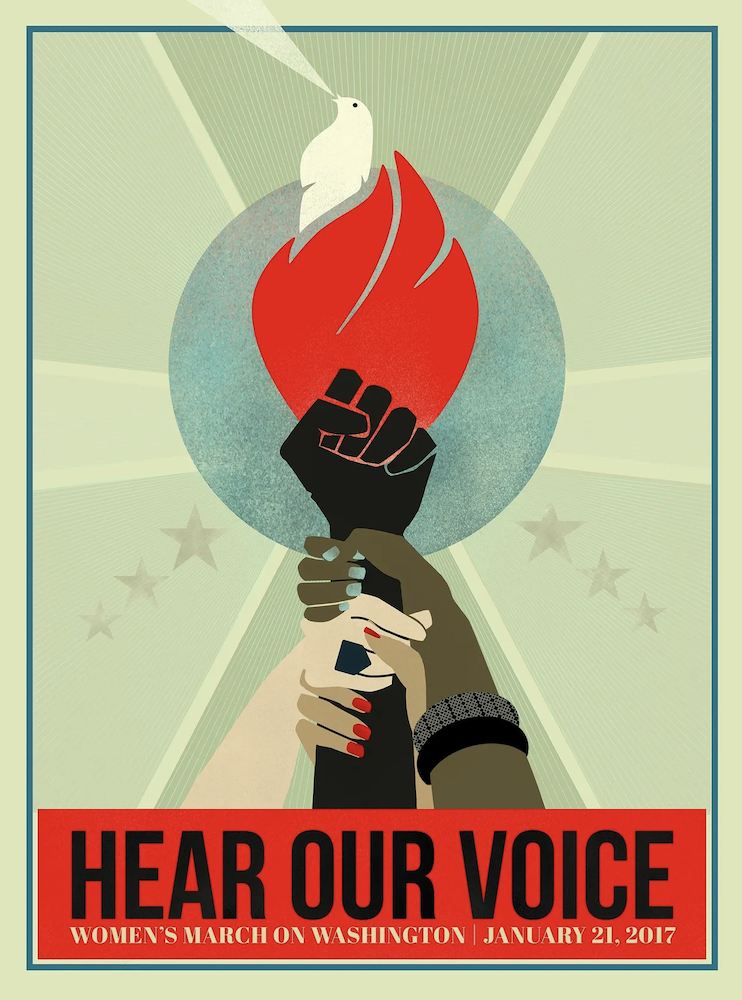
The Women’s March in January of this year was both uplifting and disturbing. It was uplifting because such a large number of people came out determined to take a stand. Even the most cynical among us conceded the makings of a movement. And yet the march was profoundly disturbing because the sheer number of white women who took to the streets on that day threw into sharp relief their absence from previous mobilisations – against police brutality, against the housing crisis, against deportations and drone strikes, against oil and gas infrastructure, against US military aid to Israel, and many other causes that disproportionately affect women of colour and indigenous women.
The whiteness of the Women’s March was not unanticipated. Before, during, and after the day of the march, debates about inclusivity and intersectional feminism lit up social media and organising spaces. The march’s original name – the Million Woman March – was changed after black activists pointed out its blatant appropriation of a 1997 black women’s rally in Philadelphia. However, the issue ran deeper than the question of the name of the march: numerous women cited a general lack of consideration for and even censoring of non-white voices in the organising process. Both the national march in Washington D.C. and local marches in other cities (notably in Portland, Oregon) underwent many challenges and changes before arriving at the final leadership line-up and speakers’ roster we encountered on the big day.
Many of those marching attended with mixed feelings, but nevertheless deemed it a worthwhile opportunity to increase the visibility of their experience: a powerful example is local D.C. activist Angela Peoples, who decided to carry a sign reading “Don’t forget: white women voted for Trump” paired with a hat emblazoned “Stop Killing Black People.” A photo of her set against the backdrop of three blonde white women in pink “pussy” hats taking selfies with the Capitol building went viral on social media and spurred multiple articles and interviews in which Angela Peoples called on white women to recognise our complicity in white supremacy and to support the organising that black women have been doing long before the rise of Trump.
In the wake of the march, think pieces from organisers and critics flourished on social media, addressing the challenges of achieving a balance between unity and accountability on such a large scale. “We can tell people a hundred times over that because they haven’t been here, they have no right to be here now. But I promise that the only place that will get us is nowhere,” wrote Alicia Garza, cofounder of Black Lives Matter, in an op-ed on the opportunity the March posed for bringing people into the movement.
Socialist organiser Keeanga-Yamahtta Taylor echoed Garza’s appeal to unity, insisting that organisers left of liberal need to be prepared to make our arguments in “political arenas that aren’t just our own.” Evoking the history of revolutionary socialism, Taylor emphasised the opportunities represented by three million people in the streets when viewed in relation to the long tradition of building united fronts. Like Garza, Taylor insists that we have a duty to keep educating as many people as possible, in as many venues as possible.
Garza and Taylor’s compelling calls to unity are vital to those of us experiencing cynicism towards the Women’s March, and chart the path for a constructive transformation of a deeply flawed though well-intentioned moment of social mobilisation. Their appeals to place and space suggest a deeper material roadblock to the building of a mass movement: rather than more-radical-than-thou attitudes, we might consider what the “here” invoked by Garza might look like, and the challenges of space and place in organising a movement. What is the “here” of the Women’s March? Is “here” a culture or a physical space? Where do we actually organise, and – perhaps more importantly – where do women lay their heads at night when a long day of organising is over?
The domestic space has always been ground zero of subversive organising; historically it was the place where secrets were kept, dissidents sought refuge, and revolutionaries rested between missions. It is also a place to emotionally recuperate and strengthen one’s spirit. Home is ideally where we create a microcosm of the world we want to live in. So why is housing justice not the first priority when it comes to women’s rights?
I thought about all the women here in the D.C. area that might have been at the march had they not been working, or sleeping off a night shift, or stressing over their housing situation, or taking care of children. Are these the women that ought to welcome white liberals into the movement? It might be difficult for them to keep the figurative door open if they can barely hold onto their literal home.
The National Mall, site of the Women’s March, is both the symbolic and political heart of America’s colonial geography. It is the destination of patriotic pilgrimage, and a space that symbolises the entirety of American domination of all spaces that lie beyond it: that is, the historical colonisation of land through a process of indigenous genocide and the enslavement of African labour, and the on-going criminalisation and economic exploitation of communities both within and beyond U.S. borders. This is not just something of the past – it is a continued system of colour-coded class stratification in which some people are born into comfort, safety and affirmation, while others are born into hardship and poverty and discrimination.
In a poem entitled “For black women that won’t march on Washington because the ‘sisterhood’ isn’t enough,” Dira Soma invokes the survival of black women through generations of violence. Acknowledging the aggressive gentrification of Washington D.C. that caused nearly half the city’s black residents to leave the city, she writes: “Let us rest easy that day, there is no fight for us in the once Chocolate City. In short time, this land will look as foreign to us as it did 400 years ago.”
For a city that recently lost its black majority for the first time in half a century – with some neighbourhoods dropping from 75 to 30 per cent black in the space of just few years – the influx of thousands of white women supposedly in the name of progress generated a jarring spatial and cultural reflection of unequal economic development.
The ‘400 years’ alludes to enslaved Africans looking around at a foreign land, forcing us to confront the foreignness of the United States itself – its foreignness to the very land that it claims. Continuous reminders of settler-colonialism must be at the core of any analysis of American violence and inequality.
Socialist organiser Keeanga-Yamahtta Taylor echoed Garza’s appeal to unity, insisting that organisers left of liberal need to be prepared to make our arguments in “political arenas that aren’t just our own.” Evoking the history of revolutionary socialism, Taylor emphasised the opportunities represented by three million people in the streets when viewed in relation to the long tradition of building united fronts. Like Garza, Taylor insists that we have a duty to keep educating as many people as possible, in as many venues as possible.
Garza and Taylor’s compelling calls to unity are vital to those of us experiencing cynicism towards the Women’s March, and chart the path for a constructive transformation of a deeply flawed though well-intentioned moment of social mobilisation. Their appeals to place and space suggest a deeper material roadblock to the building of a mass movement: rather than more-radical-than-thou attitudes, we might consider what the “here” invoked by Garza might look like, and the challenges of space and place in organising a movement. What is the “here” of the Women’s March? Is “here” a culture or a physical space? Where do we actually organise, and – perhaps more importantly – where do women lay their heads at night when a long day of organising is over?
The domestic space has always been ground zero of subversive organising; historically it was the place where secrets were kept, dissidents sought refuge, and revolutionaries rested between missions. It is also a place to emotionally recuperate and strengthen one’s spirit. Home is ideally where we create a microcosm of the world we want to live in. So why is housing justice not the first priority when it comes to women’s rights?
I thought about all the women here in the D.C. area that might have been at the march had they not been working, or sleeping off a night shift, or stressing over their housing situation, or taking care of children. Are these the women that ought to welcome white liberals into the movement? It might be difficult for them to keep the figurative door open if they can barely hold onto their literal home.
The National Mall, site of the Women’s March, is both the symbolic and political heart of America’s colonial geography. It is the destination of patriotic pilgrimage, and a space that symbolises the entirety of American domination of all spaces that lie beyond it: that is, the historical colonisation of land through a process of indigenous genocide and the enslavement of African labour, and the on-going criminalisation and economic exploitation of communities both within and beyond U.S. borders. This is not just something of the past – it is a continued system of colour-coded class stratification in which some people are born into comfort, safety and affirmation, while others are born into hardship and poverty and discrimination.
In a poem entitled “For black women that won’t march on Washington because the ‘sisterhood’ isn’t enough,” Dira Soma invokes the survival of black women through generations of violence. Acknowledging the aggressive gentrification of Washington D.C. that caused nearly half the city’s black residents to leave the city, she writes: “Let us rest easy that day, there is no fight for us in the once Chocolate City. In short time, this land will look as foreign to us as it did 400 years ago.”
For a city that recently lost its black majority for the first time in half a century – with some neighbourhoods dropping from 75 to 30 per cent black in the space of just few years – the influx of thousands of white women supposedly in the name of progress generated a jarring spatial and cultural reflection of unequal economic development.
The ‘400 years’ alludes to enslaved Africans looking around at a foreign land, forcing us to confront the foreignness of the United States itself – its foreignness to the very land that it claims. Continuous reminders of settler-colonialism must be at the core of any analysis of American violence and inequality.
For a city that recently lost its black majority for the first time in half a century – with some neighbourhoods dropping from 75 to 30 per cent black in the space of just few years – the influx of thousands of white women supposedly in the name of progress generated a jarring spatial and cultural reflection of unequal economic development.
Michelle Obama should be credited for the numerous speeches in which she reminded the American public that enslaved Africans built the Mall and the White House itself. And yet, at the Women’s March, whiteness was so at home with itself. Those who were willing and financially able to make the long trip to D.C. from points across the country were primarily white. For a city that recently lost its black majority for the first time in half a century – with some neighbourhoods dropping from 75 to 30 per cent black in the space of just few years – the influx of thousands of white women supposedly in the name of progress generated a jarring spatial and cultural reflection of unequal economic development.
While arguably bearing seeds of a greater and more inclusive movement, the Women’s March was also a critical reminder that systemic white supremacy can appear warm and earnest and well-intentioned, even as it leaves so many people out or tokenises their presence. It did not matter how many signs declared that the carrier’s feminism was “intersectional”. The demographics and overwhelming emphasis on ridiculing Trump made the march seem oblivious to the understanding of race, class and power which critical theorist Kimberlé Crenshaw first used to describe the term “intersectionality”.
The flawed reality of the march cannot be ignored or explained away. Nor should attending to it be dismissed as a divisive critique. If we will move forward together, we should face its shortcomings and neoliberal imperial hegemonic complicities in painstaking detail. No organising is radical or revolutionary if it is not accessible to the poor.
What does it mean to spend time and money to come to Washington D.C. when women are already organising around community issues of housing justice and healthcare right where you live? What does it mean to spend time and money to travel to Washington D.C. when so many women who call this city home were working long hours for poverty wages that day? What does it mean for women in Ward 3 – the highest income ward in D.C. – to take the subway downtown for the Women’s March when they have done nothing to stop their own neighbourhood from mobilising against a new shelter for homeless families?
Garza and Taylor are right to say that those of us who are left of liberal must welcome new people and engage with those outside of our usual choir. We must educate as many people as possible, in as many venues as possible. At the same time, we must consider the very concrete and political role of space and place in organising. While making the organising space feel welcoming to economically comfortable white women who don’t yet have an analysis of structural racism, it is even more critical to make organising spaces accessible to poor women of colour bearing the brunt of an economy based in exploitative wage labour and real estate speculation. In this case, perhaps the most essential aspect of movement “accessibility” is simply the right to a home.
Capitalism in the United States and around the world is not just a system of economic exploitation; it’s also the insidious scripting of our social imagination to support that status quo. Our organising cultures are not exempt from these stifling effects. We must open our imaginations to what it may look like to build power over dinner tables, on playgrounds, public transportation, and in our places of work and study. I propose that we abandon our various pilgrimages to protest on the National Mall and instead focus our expendable time and money on supporting working-class women who live in our own cities, towns, and neighbourhoods. Only then will the whiteness of the Women’s March recede into a truly united front.
If this piece resonated with you, please consider making a donation to support One DC, a local organisation dedicated to creating a community that is equitable for all. Also look out for the next piece in this series, in which I will expand on the settler-colonial dynamics of the United States in relation to the #NoBanNoWall protests.