
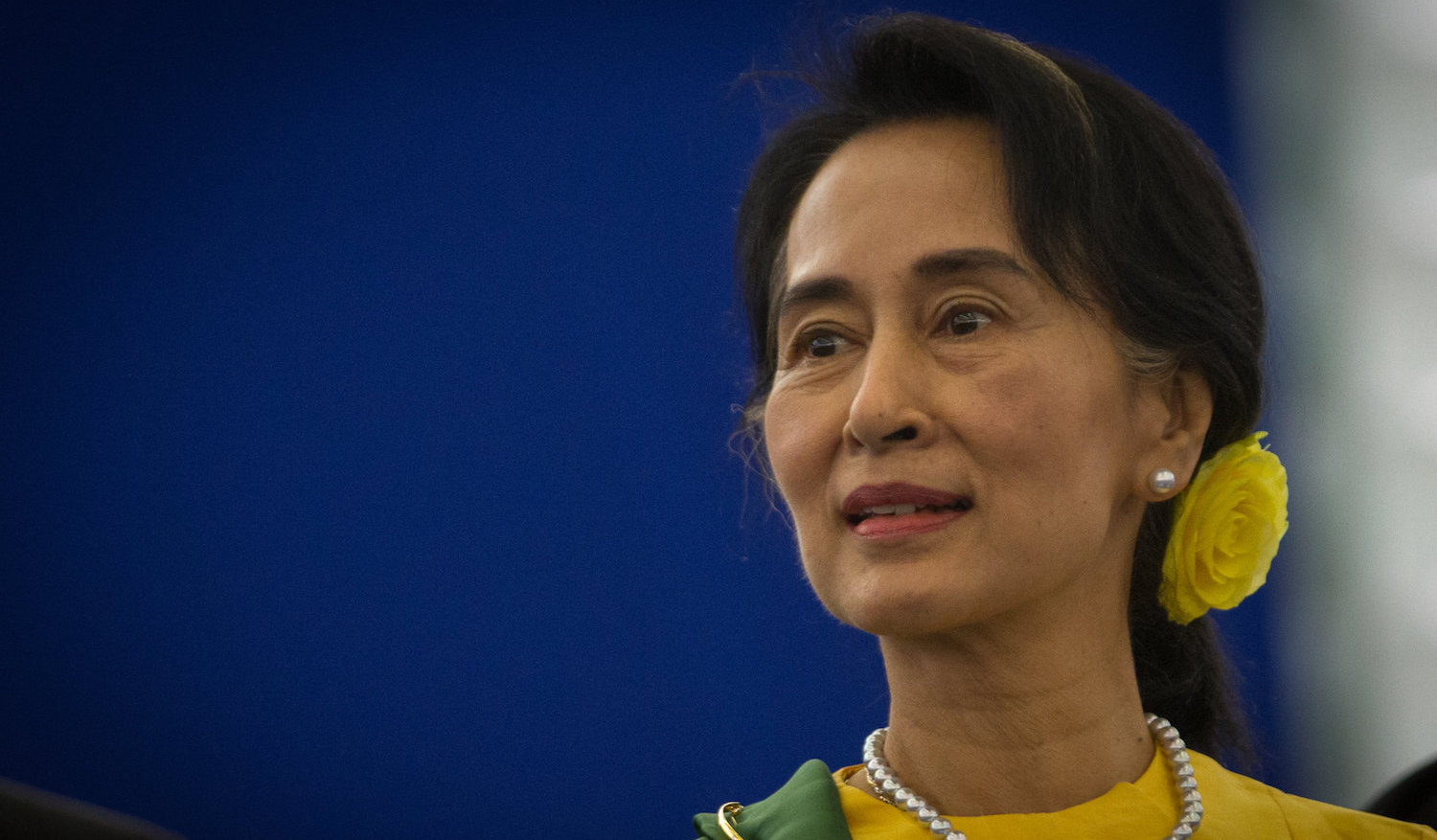
Aung Suu Kyi must be tried for genocide and crimes against humanity to bring small justice for the Rohingya people
History is replete with instances of fallen heroes, who, in spite of their celebrated achievements and decorated past, have had to suffer punishment for subsequent acts of transgression, indiscretion and excesses, if not by a court of law then by the court of public opinion.
Robespierre, one of the chief architects of the French Revolution and author of the slogan “Liberty, Equality, Fraternity”, was once dubbed “The Incorruptible” because of his unwavering commitment to democratic values. However, he is remembered today more for the terror that he unleashed on French citizens in 1793-94. He was a key figure in the execution of more than 17,000 “enemies of the Revolution” by the guillotine. Ironically, Robespierre was himself guillotined in the summer of 1794 before a cheering crowd in Paris.
One cannot help but wonder whether a similar fate awaits the once darling of democracy, Aung San Suu Kyi. She sits primly in the office of State Counsellor of Myanmar, keenly observing but stoutly denying the widespread atrocities committed by the Myanmar army against ethnic Rohingyas of the Rakhine state. In an era where we can justly take pride in a robust system of international criminal justice, trial of the most elusive perpetrators, including that of Suu Kyi, is not only a legal obligation but also a moral duty which must be fulfilled in order to maintain our faith in the promise of global transnational justice.
The charges against Suu Kyi are many. The case against her has been made on numerous occasions. As Myanmar’s de facto leader, Suu Kyi has a responsibility to rein in the violence being perpetrated by the state apparatus. The Myanmar Constitution may have only granted her limited powers, but she is not barred from protesting against the atrocities being committed. She is ultimately responsible for the state-ordained characterisation of eye witness accounts of murder and rape of ethnic Rohingyas as “fake news”. She has abused her moral authority to successfully campaign for the lifting of US sanctions only to consolidate her political position within the power structure. Regrettably, Suu Kyi has sacrificed the high ideals of democracy and freedom for which she had once strived for and turned a blind eye to the persecution of Rohingyas in order to command the support of the largely Buddhist Myanmar electorate.
These charges have seen Aung San Suu Kyi swiftly plummet from the lofty position where the international community had once placed her. Suu Kyi’s heroic endurance under house arrest had won her the Nobel Prize for Peace in 1991. Yet 25 years later, Suu Kyi’s courage in the face of adversity has given way to silence in the face of oppression. In November last year, Suu Kyi’s fellow Nobel Peace laureates urged her to condemn the atrocities of the Myanmar regime. An unprecedented online petition calling for the Nobel Committee to strip Suu Kyi of the prize gained such momentum that the head of the Norwegian Nobel Institute was forced to issue a statement that the will of the prize’s founder did not allow for withdrawal of the honour.
Other award-conferring bodies have not been quite so charitable. The Oxford City Council revoked Suu Kyi’s Freedom of Oxford award as did Glasgow and Sheffield City Councils. The London School of Economics revoked Suu Kyi’s honorary students’ union presidency, while Canada’s largest trade union, UNIFOR, revoked her honorary membership. In addition, a “People’s Court” constituted by jurists and academics in Malaysia tried and convicted her for genocide.
But public shaming is hardly sufficient punishment for wide scale atrocities. The UN High Commissioner for Human Rights, Zeid Raad Al-Hussein, termed the army action “a textbook example of ethnic cleansing” in September last year. Two months later he reiterated his claim, stating that “concordant reports of acts of appalling barbarity committed against the Rohingya” all of which suggested a state commission of genocidal violence. One only needs to visit the Kutapulong Camp in Cox’s Bazaar, Bangladesh, to meet the victims of genocide and hear first-hand harrowing accounts of arson, murder and rape by the Myanmar army. Myanmar authorities have even attempted to suppress the dissemination of news of the atrocities by harassing journalists.
Justice demands that those at the helm of authority in Myanmar, who have been involved in carrying out or covering up genocidal acts be brought to book. Prosecuting Suu Kyi will not be easy. The only court which can try perpetrators of such crimes is the International Criminal Court (ICC) at The Hague. But the ICC does not have jurisdiction to act because Myanmar is not a signatory to the Rome Statute under which the ICC assumes jurisdiction. Nor will Myanmar accept the jurisdiction of the ICC. Notwithstanding such limitations, Suu Kyi and the Myanmar authorities may still be tried by the ICC if the UN Security Council refers the matter to it. In order to refer the matter, votes of nine Security Council members are required. If history has shown anything, it is that voting at the Security Council is dictated more by expediency than by principle.
Alternative forms of judicial redress for crimes against humanity, however, do exist. This allows states or international organisations to claim criminal jurisdiction over an accused person, regardless of where the crime was committed and regardless of the accused’s nationality. The UN Security Council resolution 1674 adopted in April 2006 reaffirmed its responsibility to protect populations from genocide, ethnic cleansing and crimes against humanity. Examples of states invoking this concept of universal jurisdiction include Israel’s prosecution of Eichmann in 1961 and Spain’s prosecution of South American dictators and torturers in 2006. More recently, the Centre of Constitutional Rights tried to prosecute former US President George W. Bush – first in Switzerland and then in Canada – on behalf of the people tortured in US detention camps.
Aung San Suu Kyi and the officers of the Myanamar government, as and when they travel to a country which exercises universal jurisdiction, can and should be prosecuted. Trying Aung San Suu Kyi for genocide in the Rakhine state is necessary not only to bring justice to the victims and their families, but also to end decades of impunity enjoyed by the Myanmar regime, who have fuelled the sustained repression and consequent exodus of ethnic Rohingyas.
The international community must act swiftly and decisively to bring an end to the torture of “the most persecuted minority in the world”.
Abdur Razzaq is currently a practising member of the English Bar and was formerly a Senior Advocate of the Bangladesh Supreme Court. Rajeev Dhavan is a Senior Advocate of the Indian Supreme Court. He was formerly a Commissioner of the International Commission of Jurists.
Photo Credit: Global Media Sharing via Flickr