
Crackdowns and corruption are hindering progress in Bangladesh’s troubled political landscape
Bangladesh is no stranger to mass-scale violence. Yet recent protests, along with the subsequent crackdowns, have marked a watershed moment in the country’s history.
While the country has experienced robust economic growth and infrastructural improvements, it continues to be plagued by a myriad of issues. One such issue is Bangladesh’s troubled urban transport scene, which has only become more complicated over time. Dhaka, a city of 18 million, faces traffic gridlock on a daily basis. Commuters lose a total 3.2 million working hours daily, travelling at an average driving speed of seven kilometres per hour.
Currently, there are 6,000 city buses in operation in Dhaka, carrying a total of 300,000 passengers each day. These buses habitually overload their poorly maintained vehicles with excess passengers. Powerful officials own several private bus companies, often providing patronage to bus and rickshaw drivers. Indeed, the Shipping Minister, Shahjahan Khan, is also president of Bangladesh Road Transport Workers’ Union. The drivers’ unions are dangerously belligerent, going on strikes whenever the question of disciplinary action for reckless driving arises among the populace.
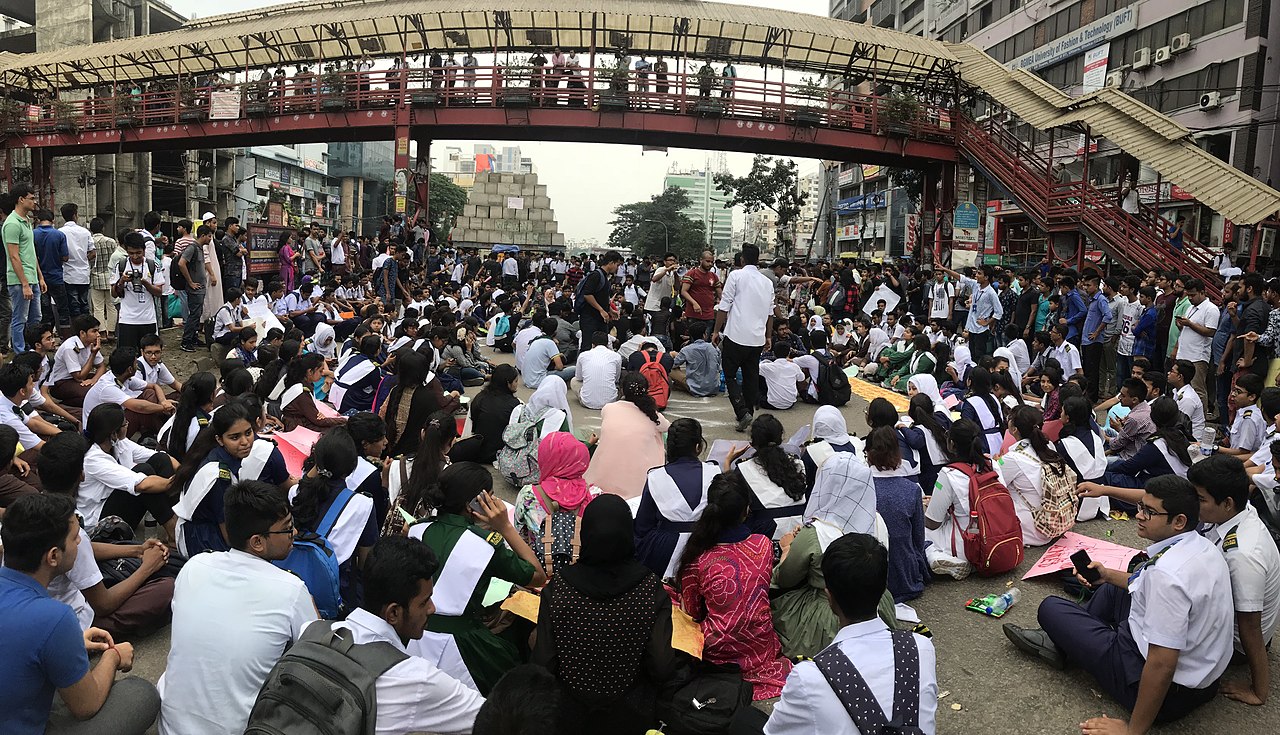
On 29th July, two students were run over and killed by a speeding bus, after the driver lost control while trying to pick up passengers. This is a worryingly normal occurrence in Bangladesh, in which 2,471 people have been killed in road accidents between January and June 2018 alone. A wave of student protests followed, starting from 30th July. Schoolchildren, numbering in the tens of thousands, blocked roads and intersections, leading to deadlock in the city. On paper, the scope of the protests is limited to the issue of road safety. For many, however, it’s a rallying cry for addressing larger problems of systemic corruption.
The protesters published a nine-point demand, urging the government to improve road safety. When the government declared that they accepted the demands and urged the students to return home on 2nd August, many protesters remained sceptical, fearing a repeat of the Quota Reform Movement’s outcome earlier in May. In this movement, students had protested against the complex reservation system for recruitment in government institutions, where 54% of available vacancies in Bangladesh’s civil service are reserved for minorities and special interest groups. Although Prime Minister Sheikh Hasina promised substantial reform, no public progress was seen in the three months that followed. Rather, leaders from the reform movement were systematically targeted, beaten, arrested and, in some cases, kidnapped.
Faced with a growing crisis that could go out of control, the government have pursued a severe crackdown since 3rd August. The police, in concert with pro-government groups, violently suppressed and injured an estimated 140 protesters and media representatives across the capital. Before the crackdowns began, internet speed was slowed down for 24 hours to 2G levels. This prevented live coverage of the attacks. Journalists and others covering the events were targeted and beaten by the attackers, who snatched and broke their phones and cameras.
On the night of 4th August, police arrested Shahidul Alam, an activist and prominent photojournalist, for criticising the government in an interview for Al Jazeera. Initially, the police denied knowledge of detaining him, before presenting a visibly limping Shahidul at court to seek a seven-day remand.
The crackdown culminated in a joint assault on several university campuses. These unidentified attackers – reportedly belonging to Bangladesh Chattra League (BCL), the student wing of the ruling Awami League – also vandalised vehicles, including one carrying US ambassador Marcia Bernicat. “Nothing can justify the brutal attacks and violence over the weekend against the thousands of young people who have been peacefully exercising their democratic rights,” the US ambassador expressed in an official statement. Since then, the UN, the EU and Amnesty International have also condemned the violence. So far, 29 cases have been filed against the protesters. Forty-one people, including 22 students of private universities, have been arrested. No cases have yet been filed against the unidentified attackers.
The current regime is in the middle of a near ten-year reign, headed by Sheikh Hasina. In the last 30 years, her party, the Awami League, and the opposition, the Bangladesh Nationalist Party (BNP), have taken turns leading the country. This perennial contest reached a turning point earlier this year, when Khaleda Zia, the head of the BNP, was sentenced to five years in jail in February, charged guilty of embezzling an orphans’ fund.
Over the years, Bangladesh’s standing in important indices has declined considerably. When the current regime first came to power in 2009, Bangladesh’s Corruptions Perceptions Index (CPI) rank was 139. Its CPI rank in 2014, when Awami League retained power in an election boycotted by the BNP, had slid down to 145, before slightly improving to 143 in 2017. Earlier this year, Germany’s Bertelsmann Foundation rated Bangladesh as a new autocracy, measuring factors such as quality of democracy, market economy and governance. “These developments are worrying for citizens,” the report stated about Bangladesh, “because corruption, social exclusion and barriers to fair economic competition continue to be more prevalent in autocracies.”
According to experts, the hardline nature of the government crackdowns could reflect panic and anxiety about the looming elections. “I think they are worried that any protests against the government could bring the opposition out on the street,” said Omar Waraich, the deputy director for South Asia at Amnesty International. “They want to crush these protests immediately – they see them for not just what they are, but what they could be.”
At the moment, the movement has largely died down. Allegedly beaten in custody, Shahidul Alam has now been charged under Section 57 of Bangladesh’s Information Communications Technology Act, which penalises those who criticise the government online, and will remain there at least until his hearing on 11th September. While the youth still harbour widespread resentment, there is an uneasy notable silence across most platforms. Social media and all forms of communications are being closely monitored by authorities.
Although a draft of the new Road Transport Act 2018 has been approved by cabinet, it has been met with substantial criticism. The maximum penalty for deaths in accidents is five years. In comparison, political dissidents can be jailed under Section 57 of the ICT Act for up to 14 years. The ICT Act itself is being reformed, but the punishments have been expanded to cover a range of offences and remain just as severe.
While further actions by citizens seem unlikely in the short term, the clouds of uncertainty circling over the south-east Asian delta have become murkier. It just might be that the calm that has descended upon Bangladesh represents a pause before a larger, deadlier storm.
Photo Credit: Asivechowdhury / Wikimedia Commons
